Picture a woman in her sixties with moderate heart failure. She lives two hours from the nearest academic hospital, no longer drives on motorways, and cares for her husband at home. A trial of a promising new therapy is recruiting at that hospital, with monthly visits for a year. However much she might want to take part, the logistics decide for her.
Multiply her by thousands and you begin to see why the clinical research community has spent the past several years asking a simple question: which trial activities actually need to happen at a research site?
Decentralized clinical trials (DCTs) are one answer. And after a period of pandemic-era improvisation, the regulatory framework around them has now matured considerably.
What "decentralized" really means
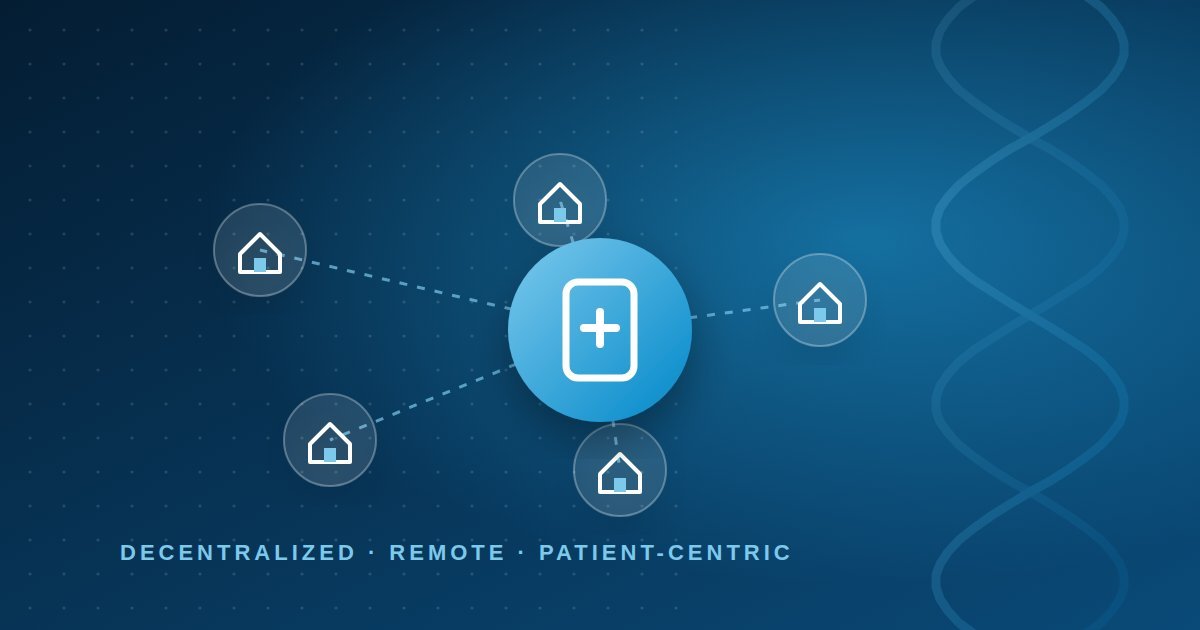
The term is often misunderstood. Very few trials are fully remote. Most are hybrid: some visits happen at the investigator's site, while others take place at the participant's home, at a local clinic or pharmacy, or through a video call. That is why regulators now prefer the phrase "clinical trials with decentralized elements".
Typical decentralized elements include:
- Telehealth visits with the investigator or study staff.
- Home visits by trained research nurses or mobile phlebotomists.
- Visits to local healthcare providers (HCPs) for routine procedures such as blood draws or imaging.
- Direct-to-participant shipping of investigational product.
- Digital health technologies (DHTs), such as wearables, connected devices and electronic clinical outcome assessments (eCOA), that collect data remotely.
- Electronic informed consent (eConsent), delivered and documented remotely.
The FDA's 2024 guidance: what it says
In September 2024, the FDA finalised its guidance Conducting Clinical Trials With Decentralized Elements, issued jointly by CDER, CBER, CDRH and the Oncology Center of Excellence. It applies to drugs, biologics and devices. A few points stand out.
The investigator is still responsible. Decentralization does not dilute accountability. The investigator must supervise all trial-related activities, including those carried out by remote staff or local HCPs, and must have a physical location where FDA inspectors can access records and interview personnel.
Local HCPs can be used sensibly. The guidance distinguishes between trial-specific activities that require the involvement of trained study personnel and routine clinical procedures that local HCPs perform as part of normal practice. The final version dropped a draft proposal requiring separate task logs for local HCPs, a change widely welcomed as reducing administrative burden without compromising oversight.
Safety monitoring must be planned, not assumed. Sponsors should describe how adverse events will be identified and managed when participants are not coming in regularly, including how participants can reach study staff and what happens if they need urgent in-person assessment.
Investigational product shipping has its own risks. Direct-to-participant shipping must protect product integrity and stability, and the sponsor must consider whether a particular product is appropriate for home administration at all. A biologic that needs cold-chain handling and close observation after dosing is a very different proposition from an oral tablet.
Technology must be fit for purpose. The guidance points to FDA's companion guidance on Digital Health Technologies for Remote Data Acquisition in Clinical Investigations, which covers the verification and validation of DHTs, their suitability for the trial population, and the handling of the data they produce.
ICH E6(R3) Annex 2: the global layer
The FDA guidance addresses US expectations. For trials that cross borders, the more important development is ICH E6(R3) Annex 2, adopted by ICH on 3 June 2026 and due to take effect in the European Union on 15 January 2027.
Annex 2 supplements the E6(R3) Principles and Annex 1, and is the first time international GCP has dealt comprehensively with three related topics:
- Decentralized elements: trial activities conducted outside traditional investigator sites, including remote interactions and home-based procedures.
- Pragmatic trial designs: studies that resemble routine clinical practice more closely, often with broader eligibility and streamlined data collection.
- Real-world data (RWD): the use of data from electronic health records, registries and other sources within a trial, with expectations that such data be reliable, traceable and fit for purpose.
Crucially, Annex 2 applies the same risk-proportionate thinking as the rest of E6(R3). Decentralized elements are neither encouraged nor discouraged for their own sake. They should be chosen when they serve the trial's scientific question and the participants' interests, and the associated risks should be identified and controlled like any other critical to quality factor.
The benefits, and the evidence behind them
The case for DCTs rests on a few well-supported arguments:
Access and diversity. Travel distance, work commitments and caregiving responsibilities are recognised barriers to participation. Reducing site visits can widen the pool of people able to enrol, including those in rural areas and groups historically under-represented in research.
Participant burden and retention. Fewer journeys and less time off work make continued participation more realistic, particularly in long studies.
Richer data. Continuous or more frequent measurement from wearables or eCOA can capture how a disease behaves in daily life, rather than on the one morning a month someone visits a clinic.
That said, it is worth being candid about the evidence. Much of the published data on DCT benefits comes from case studies and early experience rather than large randomized comparisons of trial designs. The benefits are real in many settings, but they are not automatic, and they depend heavily on how well the decentralized elements are chosen and executed.
The challenges that trial teams face
Data integrity across many hands. When data comes from home nurses, local labs, devices and participants themselves, maintaining attributable, accurate and complete records is harder. Clear data flow mapping and audit trails are essential.
Digital divide. Not every participant has reliable internet, a compatible smartphone or comfort with technology. A trial that relies entirely on an app can exclude precisely the people decentralization was meant to include. Offering alternatives, such as provisioned devices or in-person options, is good practice.
Regulatory variation. Rules on telemedicine, home nursing, direct shipping of investigational product and cross-border data transfer differ between countries. A design that works in the United States may need modification in the EU, India or elsewhere.
Safety oversight at a distance. Detecting and responding to adverse events without regular in-person contact requires deliberate planning and responsive communication channels.
Site workload. Decentralization changes, rather than removes, the work of sites. Coordinating vendors, reviewing remote data and supporting participants with technology all take time.
What this means for clinical research professionals
DCTs are reshaping job descriptions across the industry.
CRAs and monitors increasingly work with centralized dashboards and remote source review, and need to understand how data moves between vendors and systems.
CRCs often become the human link between participants, technology and home-health providers. Communication skills and comfort with digital platforms matter as much as protocol knowledge.
Clinical data managers handle more data sources, more frequent data transfers and more complex reconciliation, particularly for device and eCOA data.
Regulatory and quality professionals need to navigate differing national rules and demonstrate that decentralized elements have been risk-assessed under E6(R3).
Key takeaways
- Most modern trials are hybrid rather than fully remote; regulators talk about "decentralized elements".
- The FDA finalised its guidance on decentralized elements in September 2024. Investigator responsibility and oversight remain unchanged.
- ICH E6(R3) Annex 2, adopted in June 2026, brings decentralized elements, pragmatic designs and real-world data into international GCP.
- The benefits for access and burden are meaningful but depend on thoughtful design and execution.
- Trial teams need skills in data flow, digital tools, vendor oversight and remote safety monitoring.
Preparing for the next generation of trials
CliniXen Institute's Advanced Diploma in Clinical Research is built around the way trials are actually run today, including GCP under E6(R3), risk-based monitoring and the practical realities of hybrid trial designs. If you are looking to move into, or grow within, clinical operations, it is a good place to build that foundation.
Advanced PG Diploma in Clinical Research & Clinical Data Management
References
- US Food and Drug Administration. Conducting Clinical Trials With Decentralized Elements: Guidance for Industry, Investigators, and Other Interested Parties, September 2024. https://www.fda.gov/regulatory-information/search-fda-guidance-documents/conducting-clinical-trials-decentralized-elements
- Federal Register. Conducting Clinical Trials With Decentralized Elements; Notice of Availability, 18 September 2024. https://www.federalregister.gov/documents/2024/09/18/2024-21078/conducting-clinical-trials-with-decentralized-elements-guidance-for-industry-investigators-and-other
- US Food and Drug Administration. Digital Health Technologies for Remote Data Acquisition in Clinical Investigations: Guidance for Industry, Investigators, and Other Stakeholders, December 2023. https://www.fda.gov/regulatory-information/search-fda-guidance-documents
- International Council for Harmonisation. Guideline for Good Clinical Practice E6(R3) Annex 2, Step 4, 3 June 2026. https://database.ich.org/sites/default/files/ICH_E6(R3)_Annex%202_Guideline_Step%204_2026_0603_0.pdf
- European Medicines Agency. ICH E6 Good clinical practice - Scientific guideline. https://www.ema.europa.eu/en/ich-e6-good-clinical-practice-scientific-guideline
- Medidata. Decentralized Clinical Trials: The New FDA Guidance Analyzed, 2024. https://www.medidata.com/en/life-science-resources/medidata-blog/decentralized-clinical-trials-new-guidance-2024/
Disclaimer: This article is for educational purposes and reflects publicly available regulatory and scientific information at the time of writing. Guidance documents are updated periodically; always consult the latest official version.