Ask most people how a new medicine is made and they will picture a laboratory: glassware, pipettes, someone in a white coat. That picture is not wrong, but it is incomplete. Long before the first test tube is filled, and long after it is emptied, a drug candidate passes through two very different kinds of work. One is computational and laboratory science that finds a promising molecule. The other is clinical research that finds out, carefully and ethically, whether that molecule actually helps patients.
This article follows that journey end to end, in plain language. It is written for biotechnology, pharmacy, microbiology and life science graduates who keep hearing both “bioinformatics” and “clinical research” and want to see how the two connect. By the end you should be able to place almost any job title in the industry somewhere on this path.
The shape of the journey
A useful way to think about drug development is as a funnel. At the wide end sit vast numbers of possibilities. At the narrow end sits one approved medicine, if a project is very fortunate. Every stage exists to remove candidates that will not work, as early and as cheaply as possible, so that human beings are only asked to take part at the point where there is a genuine scientific reason to do so.
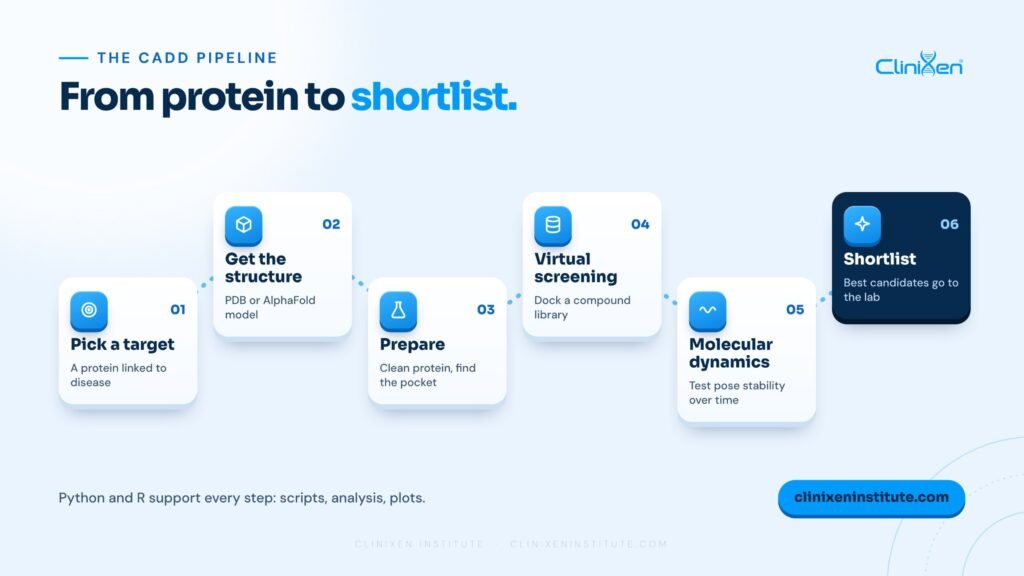
That funnel runs roughly like this: choose a biological target, understand its structure, narrow the chemical possibilities, test the survivors in the laboratory, then test the best of those in people through clinical trials. The stages overlap in practice, and projects loop backwards often.
Stage 1: Choosing a target
Almost every medicine works by interacting with something in the body, usually a protein such as an enzyme, a receptor or a transporter. That something is called the target. Choosing it well is the single most important decision in a project.
Target selection draws on genetics, disease biology and published evidence. Teams ask whether the protein is genuinely involved in the disease, whether changing its activity is likely to help rather than harm, and whether it can realistically be reached by a drug. Public resources such as UniProt, Ensembl and the scientific literature do much of the early work here, which is why data skills matter from the very first stage.
Stage 2: Seeing the protein in three dimensions
Once a target is chosen, the team needs to know its shape. A protein is a long chain of amino acids that folds into a specific three-dimensional form, and that form determines what can bind to it and where.
Experimental structures
The Protein Data Bank (PDB) is the global archive of experimentally determined three-dimensional structures of proteins, DNA and RNA. These structures come from laboratory techniques such as X-ray crystallography, nuclear magnetic resonance and cryo-electron microscopy. The archive has grown steadily for five decades: by the end of February 2026 it contained more than 250,000 entries.
Predicted structures
When no experimental structure exists, a predicted model can fill the gap. AlphaFold, developed by Google DeepMind, predicts a protein’s three-dimensional structure from its amino acid sequence, and the AlphaFold Protein Structure Database provides predicted structures on a scale no laboratory could match.
How significant was that shift? The 2024 Nobel Prize in Chemistry was awarded with one half to David Baker for computational protein design, and the other half jointly to Demis Hassabis and John Jumper for protein structure prediction. Structural biology done with computers is no longer a side discipline. It sits at the centre of modern biology.
For a learner, the practical message is simple: being able to find a structure, open it, and judge how reliable it is has become a basic professional skill, much like being able to read a research paper.
Stage 3: Narrowing the chemistry
With a target and a structure in hand, the question becomes which molecules are worth making and testing. The number of possible drug-like molecules is far larger than any laboratory could ever synthesise, so the search has to be narrowed before it reaches the bench.
This is the work of computer-aided drug design. Software models how candidate molecules might interact with the target protein and ranks them, so that chemists can focus their effort. Teams also apply filters that remove molecules unlikely to behave like medicines in the body, considering properties such as absorption and likely toxicity.
Two cautions matter here. First, computational predictions are hypotheses, not measurements. Second, only a small share of computational hits survive laboratory testing. The value of this stage is not certainty. It is direction: it tells the laboratory where to look first.
Stage 4: Into the laboratory
Shortlisted molecules now face real biology. Assays measure whether a compound binds the target and whether it changes the target’s activity as intended. Promising compounds are modified and re-tested in cycles, improving potency, selectivity and stability. A compound that survives this stage is usually called a lead.
Preclinical research then asks a harder question: is this molecule safe and promising enough to justify giving it to a person? This involves laboratory and animal studies of how the body handles the compound and what harm it might cause, conducted under strict regulatory expectations. Only after this evidence is assembled can a sponsor apply to regulators to begin human studies.
Stage 5: Into people, carefully
Clinical trials are where a candidate finally meets patients, and where a completely different professional world takes over. Trials are conducted in phases, each with a different question at its centre.
- Phase 1 focuses on safety and tolerability, usually in a small group of participants, and on how the body processes the drug.
- Phase 2 looks for early evidence that the drug works in the intended condition, while continuing to study safety and dose.
- Phase 3 tests the drug in a much larger group, usually against an existing treatment or placebo, to confirm benefit and detect less common risks.
- Phase 4 continues after approval, monitoring safety and performance in everyday use.
Running these studies is governed by ethics and regulation rather than by curiosity alone. The Declaration of Helsinki sets out the ethical principles for medical research involving people, including informed, voluntary consent and independent ethics committee review. ICH Good Clinical Practice translates those principles into working standards for how trials are designed, conducted and recorded. Pharmacovigilance then watches over safety both during trials and for as long as the medicine is in use.
Where the two kinds of work sit
Laid out this way, the industry’s job titles stop looking like a jumble.
- Bioinformatics and structural biology roles cluster around stages one to three: working with sequences, structures and chemical data, writing analysis scripts, and helping decide which candidates deserve laboratory time.
- Clinical research and data management roles cluster around stage five: coordinating study sites, monitoring quality, managing trial data, and reporting safety information to regulators.
- Pharmacovigilance roles run alongside and beyond the trials, assessing adverse event reports and periodic safety reviews for as long as a product is on the market.
Neither side is a lesser version of the other, and neither is complete without the other. A beautifully modelled molecule that is never tested properly helps nobody. A flawlessly run trial of a poorly chosen candidate helps nobody either.
Skills worth building, whichever side you choose
- Read the primary sources. Guidelines, regulatory notices and structure databases are public. Professionals quote them directly rather than relying on summaries.
- Learn to handle data. Comfort with spreadsheets, basic statistics and at least one of Python or R travels well across both kinds of work.
- Work on the command line. Many scientific tools run on Linux servers rather than on a laptop.
- Document what you do. In both computational and clinical work, an undocumented result is close to useless. Reproducibility and traceability are professional habits, not paperwork.
- Understand the ethics. Anyone who touches human data or human participants should be able to explain consent and confidentiality in their own words.
Frequently asked questions
Do I need a PhD to work in drug discovery?
Not for every role. Research leadership positions often expect a doctorate, but many data, laboratory support, clinical operations and safety roles are open to graduates and postgraduates with the right practical skills.
Can a biology graduate move into computational work?
Yes, and domain knowledge is an advantage. The scripting can be learned; understanding what a protein or an adverse event actually means is harder to pick up.
Which side should I learn first?
Go by the work you want to do daily. If you enjoy structures, patterns and code, the computational side will suit you. If you prefer process, coordination, documentation and contact with sites and teams, clinical research and data management will suit you better.
The takeaway
A medicine is not discovered in a single moment. It is narrowed down, stage by stage, by people with very different skills who rarely sit in the same room. The computational scientist who ranks a molecule and the study coordinator who consents a participant are working on the same object, years apart.
Knowing where each stage sits, and what question it is trying to answer, makes the whole industry easier to read: its job titles, its guidelines and its news.
Sources
- wwPDB / RCSB PDB archive milestone, February 2026: more than 250,000 entries.
- The Nobel Prize in Chemistry 2024, NobelPrize.org: David Baker (computational protein design); Demis Hassabis and John Jumper (protein structure prediction).
- AlphaFold Protein Structure Database, Google DeepMind and EMBL-EBI.
- World Medical Association, Declaration of Helsinki.
- ICH Good Clinical Practice guideline.