Every stent, glucometer, MRI scanner and diagnostic kit used in an Indian hospital passes through a regulator before it reaches a patient. In October 2024, that regulator took an important step onto the global stage.
What happened
On 3 October 2024, the Ministry of Health and Family Welfare announced that the Central Drugs Standard Control Organization (CDSCO) had been approved as an Affiliate Member of the International Medical Device Regulators Forum (IMDRF).
CDSCO applied for the membership in 2024. The approval followed discussions between the IMDRF Management Committee and senior CDSCO officers at the 26th IMDRF Session, held in September 2024 in Seattle, USA.
The ministry described the goals plainly: align India's medical device rules with globally accepted standards, make the domestic industry more competitive, and strengthen "Brand India" in the global market.
For students and professionals in clinical research, this is more than a policy headline. It is a signal of where the regulatory jobs of the next decade will be.
What is IMDRF, and why does membership matter?
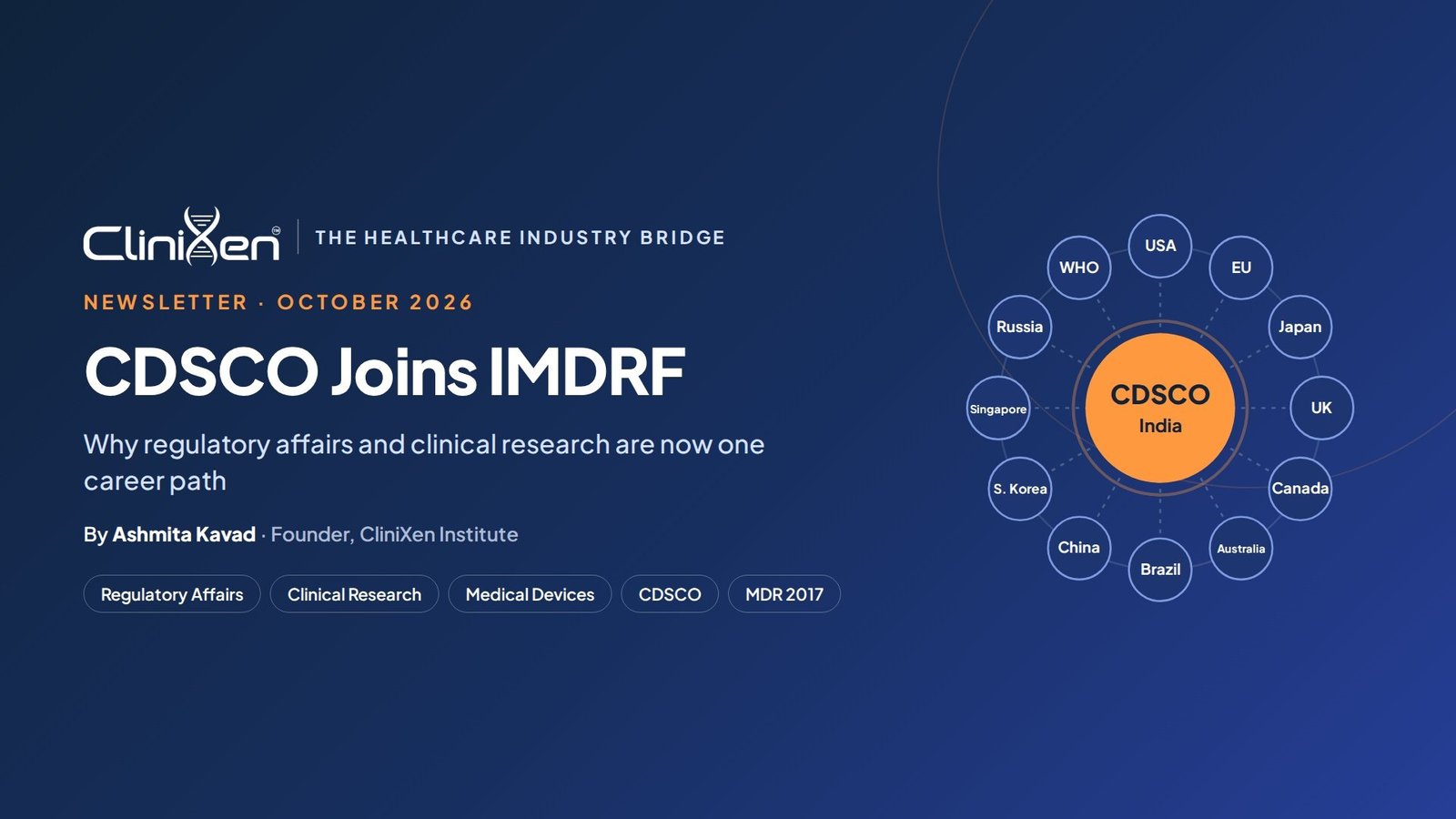
The International Medical Device Regulators Forum was set up in 2011 as a group of medical device regulators working to harmonise and converge device regulations across countries. Its members include the national regulators of the United States, Australia, Canada, the European Union, Japan, the United Kingdom, Brazil, Russia, China, South Korea and Singapore, along with the World Health Organization.
When regulators agree on common definitions, risk classes and documentation standards, a manufacturer does not have to rebuild its evidence from scratch for every country. That saves time, lowers cost and helps patients get access to new devices sooner.
According to the PIB release, as an Affiliate Member India can now:
- take part in IMDRF Open Sessions and exchange technical information with other regulators;
- join discussions on the latest device regulatory strategies and trends;
- share feedback on India's own experience and perspective;
- use IMDRF documents, in part or in full, as the basis for India's medical device regulatory framework.
The last point is the one with the biggest long-term impact. It means Indian device regulation will increasingly speak the same technical language as the world's major regulators, and the professionals who work with it will need to as well.
How India regulates medical devices today
IMDRF membership builds on a framework India already has. Medical devices in India are governed by the Medical Devices Rules, 2017 (MDR 2017), made under the Drugs and Cosmetics Act, 1940, and administered by CDSCO under the Drugs Controller General of India (DCGI).
MDR 2017 sorts every device into one of four risk classes, an approach that mirrors the risk-based classification used by regulators worldwide:
| Class | Risk level | Typical examples | Licensing authority |
|---|---|---|---|
| A | Low | Examination gloves, bandages | State Licensing Authority (manufacture) |
| B | Low to moderate | Hypodermic needles, suction equipment | State Licensing Authority (manufacture) |
| C | Moderate to high | Ventilators, bone fixation plates, dialysis equipment | Central Licensing Authority (CDSCO) |
| D | High | Heart valves, active implants, HIV diagnostic kits | Central Licensing Authority (CDSCO) |
The DCGI acts as the Central Licensing Authority for Class C and D devices, while State Drug Controllers license the manufacture of Class A and B devices. Import licences are granted centrally.
The framework has tightened steadily. Under GSR 102(E) of February 2020, devices were brought under regulation in phases, and since 1 October 2023 every Class C and Class D device, including those that were earlier "non-notified", must hold a CDSCO licence before it can be manufactured or imported for sale.
In short, India has spent the last few years building a full licensing system. IMDRF membership is the next step: making sure that system lines up with the rest of the world.
Where clinical research meets regulatory affairs
It is easy to think of clinical research and regulatory affairs as two separate careers. In practice, they are two halves of the same job: one team generates the evidence that a product is safe and effective, and the other turns that evidence into an approval, and keeps it valid for as long as the product is on the market.
Here is where the two meet in India today.
Clinical studies need regulatory permission first. For drugs, the New Drugs and Clinical Trials Rules, 2019 (NDCT Rules) replaced Schedule Y and set clear review timelines: 30 days for trial applications on drugs developed in India and 90 days for those developed abroad. Higher-risk medical devices go through a similar route under MDR 2017, where a clinical investigation needs CDSCO permission before the first participant is enrolled. Regulatory affairs professionals prepare these applications; clinical research teams design the protocol that goes into them.
Ethics committees sit between the two. Under the NDCT Rules, every trial site is overseen by an ethics committee registered with CDSCO, and studies are registered with the Clinical Trials Registry of India (CTRI). Knowing what an ethics committee expects, and how to respond to its queries, is a core skill on both sides.
Evidence must meet a global standard. As CDSCO adopts IMDRF guidance, the clinical data in an Indian dossier will increasingly need to match what regulators in the US, EU or Japan expect. That raises the bar for protocol design, data quality and documentation, and rewards professionals who understand ICH-GCP and international formats.
Safety does not stop at approval. For drugs, India runs the Pharmacovigilance Programme of India (PvPI). For devices, the Materiovigilance Programme of India (MvPI), approved by the Health Ministry on 6 July 2015, collects and analyses device-related adverse events, with the Indian Pharmacopoeia Commission as its National Coordination Centre. In July 2025, the National Medical Commission directed medical colleges to set up committees to monitor device adverse events and register them with the IPC. Every one of those reports is clinical safety data that regulatory teams must track and act on.
Career roles at the meeting point
As India aligns with global device standards, the demand grows for people who can work across both clinical research and regulatory affairs. Some of the roles where these skills come together:
| Role | What the work involves | Where you will find it |
|---|---|---|
| Regulatory Affairs Associate | Preparing dossiers and applications, tracking CDSCO notices, answering regulator queries | Pharma and device companies, CROs, regulatory consultancies |
| Clinical Research Associate (CRA) | Monitoring trial and device investigation sites, checking GCP compliance and data quality | CROs, sponsors, site management organisations |
| Clinical Data Manager | Building and cleaning study databases so the evidence holds up in a submission | CROs, pharma, device companies |
| Drug Safety / Materiovigilance Associate | Processing adverse event reports for drugs and devices, supporting safety updates | Pharmacovigilance units, device makers, hospitals |
| Medical Writer | Writing protocols, clinical study reports and regulatory summaries | Pharma, CROs, medical communications firms |
The skills that carry across all of these roles are the same: a working knowledge of the NDCT Rules and MDR 2017, ICH-GCP, how a regulatory submission is put together, adverse event reporting, and the ability to handle clinical data accurately. Increasingly, familiarity with international guidance, including IMDRF documents, will set candidates apart.
Key takeaways
- In October 2024, CDSCO became an Affiliate Member of IMDRF, the global forum of medical device regulators.
- India can now use IMDRF documents as a basis for its device rules, moving Indian regulation closer to the US, EU, Japan and other major markets.
- India regulates devices under MDR 2017 in four risk classes, and since 1 October 2023 every Class C and D device needs a CDSCO licence.
- Clinical research produces the evidence; regulatory affairs turns it into an approval and keeps it valid through safety monitoring.
- Professionals who understand both, including NDCT Rules, MDR 2017, ICH-GCP and adverse event reporting, are best placed for the roles this creates.
Build a career where research meets regulation
CliniXen Institute's 6-month, AI-integrated Advanced PG Diploma in Clinical Research & Clinical Data Management and Advanced PG Diploma in Clinical Research & Pharmacovigilance cover the clinical trial lifecycle, regulatory requirements, safety reporting and the tools used in industry today.
Explore the programs at clinixeninstitute.com or call +91 91089 56193 to book a free counselling session.
Advanced PG Diploma in Clinical Research & Clinical Data Management
References
- Press Information Bureau, Ministry of Health and Family Welfare. "Central Drugs Standard Control Organization under Ministry of Health & Family Welfare becomes Affiliate Member of the International Medical Device Regulators Forum." 3 October 2024. https://www.pib.gov.in/PressReleaseIframePage.aspx?PRID=2061397
- Central Drugs Standard Control Organisation. "New Drugs and Clinical Trials Rules, 2019." https://cdsco.gov.in/opencms/resources/UploadCDSCOWeb/2022/new_DC_rules/NEW%20DRUGS%20ANDctrS%20RULE,%202019.pdf
- Central Drugs Standard Control Organisation. "IVD FAQs under Medical Devices Rules, 2017." https://cdsco.gov.in/opencms/export/sites/CDSCO_WEB/Pdf-documents/IVD/FAQs/CDSCO-IVD-FAQ-03-2022-.pdf
- CliniExperts. "Legal Implications of the CDSCO License Update for Class C and Class D Medical Devices." https://cliniexperts.com/legal-implications-of-the-cdsco-license-update-for-class-c-and-class-d-medical-devices/
- Indian Pharmacopoeia Commission. "Materiovigilance Programme of India: About Us." https://ipc.gov.in/mandates/materiovigilance-programme-of-india-mvpi/about-us.html
- The Week (PTI). "NMC directs colleges to form panels to track adverse events from devices." 15 July 2025. https://www.theweek.in/wire-updates/national/2025/07/15/des116-health-nmc-adverse-events.html
Disclaimer: This article is for educational purposes and reflects publicly available regulatory and scientific information at the time of writing. Guidance documents are updated periodically; always consult the latest official version.