Clinical research is one of the few life sciences fields in India where a pharmacy, life sciences or medical graduate can move into a structured industry role without a PhD. Every new medicine, vaccine and medical device has to be tested in carefully controlled studies, and those studies need trained people to run sites, monitor quality, manage data and track safety.
This guide explains how clinical research works in India, who can enter the field, which roles exist, and a practical plan to get started, wherever in India you live.
How clinical research is regulated in India
Knowing the regulatory landscape is the first thing interviewers check, so it is worth getting the basics right.
- CDSCO and the DCGI: the Central Drugs Standard Control Organisation, headed by the Drugs Controller General of India, is the national regulator that approves clinical trials of new drugs.
- New Drugs and Clinical Trials Rules, 2019 (NDCT Rules): the main rulebook for trials in India. Among other things, the rules set defined review timelines (30 working days for trial applications on drugs developed and manufactured in India, 90 working days for others), require ethics committees to be registered with the regulator, and lay down how compensation for trial-related injury is decided.
- Clinical Trials Registry – India (CTRI): hosted by ICMR's National Institute of Medical Statistics and a WHO primary registry. Registration of trials in CTRI has been mandatory since 2009.
- ICMR National Ethical Guidelines (2017): the reference for ethics in biomedical and health research involving human participants.
- ICH-GCP: the international Good Clinical Practice standard. Its latest revision, ICH E6(R3), emphasises quality by design and risk-proportionate oversight.
Who can build a career in clinical research
Most entry-level roles are open to graduates and postgraduates from these backgrounds:
- B.Pharm, M.Pharm and Pharm.D
- B.Sc / M.Sc in life sciences, biotechnology, microbiology, biochemistry and related subjects
- MBBS, BDS, BHMS and BAMS
- Nursing and allied health graduates, and healthcare professionals looking to move into industry
Your degree gets you shortlisted; what gets you hired is evidence that you understand trial processes, documentation and the regulations above.
Clinical research roles explained
Clinical Research Coordinator (CRC)
Works at the hospital or trial site. Coordinates participant visits, informed consent documentation, source records and communication between the investigator, sponsor and ethics committee. A common first role for freshers.
Clinical Research Associate (CRA)
Monitors sites on behalf of the sponsor or CRO, checking that the trial follows the protocol, GCP and regulations, and that data are accurate and verifiable. Usually needs prior site or in-house experience.
Clinical Data Management (CDM)
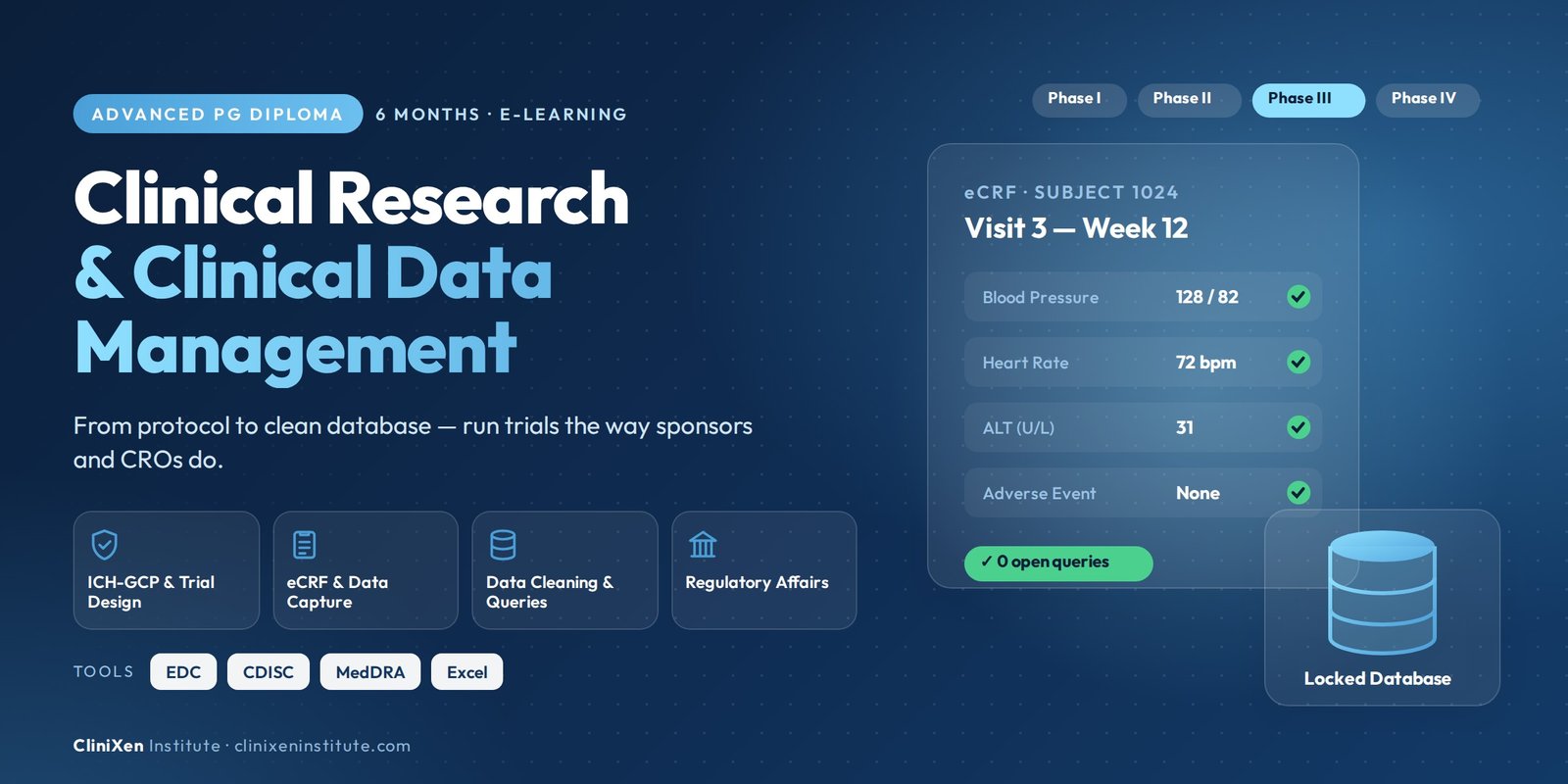
Clinical data coordinators and associates design case report forms, set up edit checks in EDC systems, raise and resolve queries, code medical terms and prepare the database for lock. Many CDM roles are office- or remote-based. See our Clinical Research & Clinical Data Management program.
Pharmacovigilance (drug safety)
Drug safety associates process adverse event reports, code them in MedDRA, write case narratives and support safety reporting. It is one of the largest hiring areas for life sciences graduates in India. Read our pharmacovigilance career guide.
Clinical SAS / statistical programming
Programmers convert trial data into CDISC SDTM and ADaM datasets and produce tables, listings and figures for study reports and regulatory submissions. Suited to candidates who enjoy logic and coding. See Clinical SAS vs R and CDISC.
Regulatory affairs and medical writing
Regulatory associates prepare and track submissions to CDSCO and other agencies; medical writers draft protocols, informed consent forms and clinical study reports.
Where the jobs are
Clinical research employers in India include pharmaceutical and biotech sponsors, contract research organisations (CROs), site management organisations, hospitals and research institutes, and specialist data and drug-safety service providers. Large hubs include Bengaluru, Hyderabad, Mumbai, Pune, Chennai, Delhi NCR and Ahmedabad, but data management, pharmacovigilance and programming roles are increasingly hybrid or remote, which opens the field to candidates from smaller cities too.
Skills employers look for
- Clear understanding of the drug development process and trial phases
- ICH-GCP E6(R3), informed consent and ethics committee processes
- Indian regulations: NDCT Rules 2019, CTRI and the role of CDSCO
- Good documentation practice (ALCOA+), trial master file and essential documents
- For CDM: CRF design, EDC concepts, query management and MedDRA/WHODrug coding
- Strong written English, attention to detail and comfort with Excel
A practical plan to get started
- Pick a track. Site operations, data management, drug safety or programming each need a slightly different skill set.
- Learn the regulations properly. Read the ICH E6(R3) guideline and the NDCT Rules summary rather than relying only on notes.
- Practise on realistic material. Work through mock CRFs, query scenarios, case narratives or SAS datasets so you can talk about real tasks in interviews.
- Prepare for interviews. Expect questions on GCP principles, trial phases, informed consent and your chosen track.
- Keep learning. Follow regulatory updates from CDSCO, ICH and global agencies; this field changes every year.
Key takeaways
- Clinical research in India is governed by CDSCO under the NDCT Rules 2019, with mandatory trial registration in CTRI.
- Pharmacy, life sciences, medical and allied health graduates can all enter the field.
- Entry roles span site coordination, data management, drug safety and programming.
- Many roles are hybrid or remote, so you can build this career from anywhere in India.
Learn clinical research online with CliniXen
CliniXen Institute's 6-month online Advanced PG Diplomas in Clinical Research & Clinical Data Management and Clinical Research & Pharmacovigilance combine live classes, recorded lectures and interview preparation, and are open to learners across India. Compare all courses.
Advanced PG Diploma in Clinical Research & Clinical Data Management
References
- Central Drugs Standard Control Organisation (CDSCO), Government of India. https://cdsco.gov.in/
- Clinical Trials Registry – India (CTRI), ICMR-NIMS. https://ctri.nic.in/
- ICH E6(R3) Guideline for Good Clinical Practice, Step 4 (2025). https://database.ich.org/sites/default/files/ICH_E6(R3)_Step4_FinalGuideline_2025_0106.pdf
Disclaimer: This article is for educational purposes and reflects publicly available regulatory and scientific information at the time of writing. Guidance documents are updated periodically; always consult the latest official version.