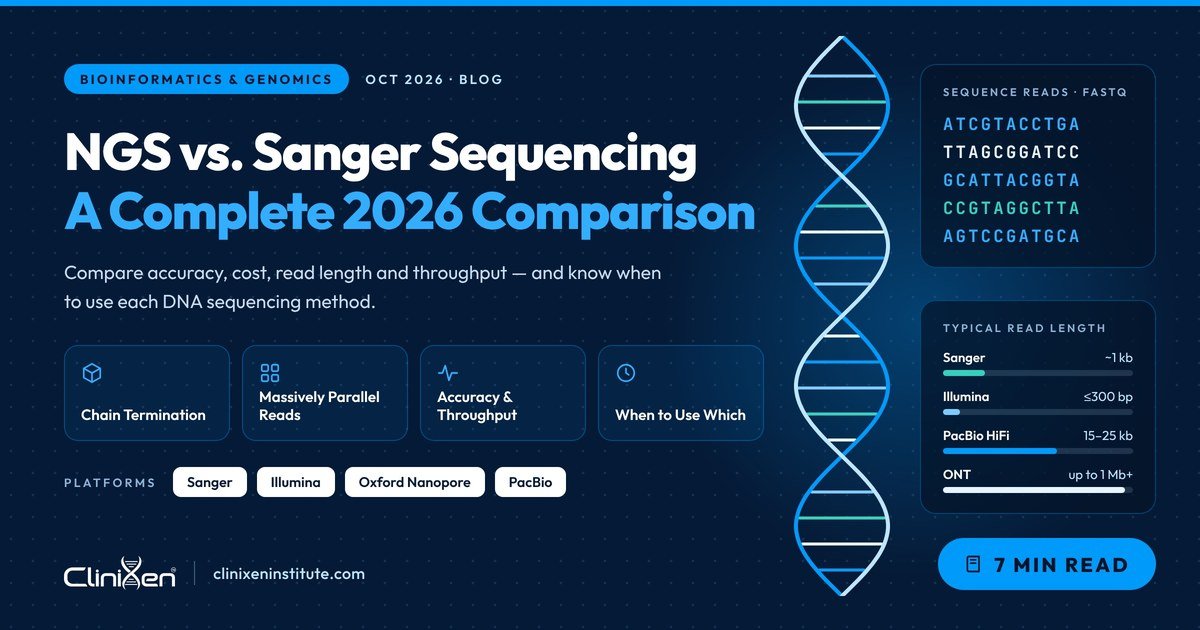
Introduction: Why Sequencing Matters in 2026
Every diagnosis that begins with "we found a variant in your gene" starts with one step: reading DNA. That single step now underpins cancer care, rare disease diagnosis, newborn screening, infectious disease surveillance, crop improvement and drug discovery.
Two families of technology do most of that reading. Sanger sequencing, developed by Frederick Sanger in 1977, reads one DNA fragment at a time with exceptional accuracy. Next-Generation Sequencing (NGS) reads millions to billions of fragments in parallel, turning what was once a decade-long, multi-billion-dollar project into a routine overnight run.
If you are a life sciences student or early-career researcher, the question is no longer "which one is better?" It is "which one fits this question, this sample and this budget?" This guide answers that, with a head-to-head comparison and a clear decision framework.
Sanger Sequencing: The Gold Standard (1977–2010)
Sanger sequencing is based on chain termination. DNA polymerase copies a template strand, and occasionally incorporates a modified nucleotide (a dideoxynucleotide, ddNTP) that stops the chain from growing. Each of the four ddNTPs carries a different fluorescent label. The resulting fragments are separated by size using capillary electrophoresis, and a laser reads the colour at the end of each fragment to produce the sequence.
What Sanger does well
- High per-base accuracy for a single, clean read, typically around 99.99%.
- Read lengths of roughly 700–1,000 bases, long enough to cover most PCR amplicons in one go.
- Simple data: one chromatogram per sample, interpretable without heavy computing.
- Fast and cheap for small jobs: a handful of amplicons can be turned around in a day.
Where it falls short
Sanger reads one fragment per reaction. That made the Human Genome Project, completed in 2003 largely on Sanger chemistry, a roughly 13-year, multi-billion-dollar international effort. It also has limited sensitivity for mixed samples: a variant present in fewer than about 15–20% of the DNA molecules (as is common in tumour samples) is often invisible on a chromatogram.
From roughly 2005 onward, as NGS platforms arrived, Sanger moved from being the workhorse to being the specialist tool it is today.
Next-Generation Sequencing: Platforms Compared (Illumina, ONT, PacBio)
NGS is not one technology but several. What they share is massive parallelism: millions of DNA molecules are sequenced at the same time, and software assembles or aligns the reads afterwards. The three platform families you will meet most often:
Illumina (short-read, sequencing by synthesis)
DNA fragments are bound to a flow cell, amplified into clusters, and read base by base using fluorescently labelled, reversible terminator nucleotides. Reads are short, commonly 2 × 150 bases, but extremely accurate and produced in enormous volumes. Illumina remains the default for whole-genome sequencing (WGS), whole-exome sequencing, RNA-seq and most clinical gene panels.
Oxford Nanopore Technologies, ONT (long-read, nanopore)
Single DNA or RNA molecules are pulled through a protein nanopore, and changes in electrical current are decoded into bases. Reads routinely run to tens of kilobases, and ultra-long reads can exceed a megabase. Devices range from the pocket-sized MinION to high-throughput PromethION. ONT can also detect DNA methylation directly and deliver data in real time, which makes it popular for field sequencing and outbreak surveillance.
PacBio (long-read, single-molecule real-time, SMRT)
A single polymerase is watched in real time as it copies a circular DNA molecule. Because the same molecule is read many times, PacBio's HiFi reads combine long length (typically 15–20 kb) with very high accuracy. HiFi has become a leading choice for de novo genome assembly and for resolving structural variants and repetitive regions that short reads struggle with.
Accuracy, Cost, and Throughput: Head-to-Head Data Table
| Parameter | Sanger | Illumina (short-read NGS) | ONT (long-read NGS) | PacBio HiFi (long-read NGS) |
|---|---|---|---|---|
| Principle | Chain termination + capillary electrophoresis | Sequencing by synthesis | Nanopore current sensing | Single-molecule real-time (circular consensus) |
| Typical read length | ~700–1,000 bp | 50–300 bp (often 2 × 150) | 10 kb to >1 Mb | ~15–20 kb |
| Per-read accuracy | ~99.99% | >99.9% | ~99% and improving with newer chemistry | >99.9% |
| Throughput per run | One fragment per reaction (96–384 per instrument run) | Up to billions of reads | Millions of reads, real time | Millions of reads |
| Low-frequency variant detection | ~15–20% allele frequency | ~1–5% (lower with deep sequencing) | Depends on depth and error profile | Depends on depth |
| Best suited for | Few targets, confirmations, clones | WGS, exomes, panels, RNA-seq | Structural variants, field work, methylation | De novo assembly, complex regions |
| Bioinformatics load | Minimal | High | High | High |
The cost story
According to long-running data from the US National Human Genome Research Institute (NHGRI), the cost of sequencing a human genome fell from around $100 million in 2001 to about $1,000 by the mid-2010s, a drop far faster than Moore's Law. Today's highest-throughput short-read instruments advertise a reagent cost close to $200 per human genome, while full clinical WGS (including interpretation) costs considerably more.
The catch: NGS is cheap per base, not per sample. For three PCR amplicons, a Sanger run is still faster and cheaper than preparing an NGS library.
Clinical Applications: When to Choose Which Method
Choose Sanger when you need to:
- Confirm a specific variant already found by NGS (still common practice in many labs, though increasingly replaced by high-quality NGS calls).
- Test a known family mutation in relatives (cascade testing).
- Check a plasmid insert, CRISPR edit or cloned construct.
- Sequence a small number of genes or amplicons, usually fewer than about 20 targets.
Choose NGS (short-read) when you need to:
- Screen many genes at once: hereditary cancer panels, cardiomyopathy panels, and similar.
- Run whole-exome or whole-genome sequencing for rare disease diagnosis.
- Profile tumours and detect low-frequency somatic mutations, including liquid biopsy.
- Measure gene expression (RNA-seq) or study microbial communities (metagenomics).
Choose long-read NGS when you need to:
- Resolve structural variants, repeat expansions or highly similar gene families.
- Assemble a new genome from scratch.
- Phase variants onto maternal and paternal chromosomes.
- Sequence pathogens rapidly in the field.
A simple rule of thumb: few targets, known question → Sanger. Many targets or unknown question → NGS. Complex structure or new genome → long-read NGS.
Career Opportunities in Sequencing Technology
The shift from Sanger to NGS changed the bottleneck in genomics. Generating data is no longer the hard part; analysing it is. That is why sequencing has created strong demand for people who combine biology with computational skills.
Roles you will see in job listings
- Genomics Analyst: runs QC, alignment and variant calling pipelines.
- Variant Scientist / Clinical Variant Curator: interprets variants against ACMG guidelines for diagnostic reports.
- Bioinformatics Engineer: builds and scales pipelines on HPC and cloud platforms.
- NGS Application Scientist: supports labs and customers for sequencing companies.
Skills employers ask for
Linux command line, Python (BioPython) or R (Bioconductor), FASTQ/BAM/VCF formats, alignment with BWA, variant calling with GATK, workflow managers such as Nextflow or Snakemake, and familiarity with cloud computing.
Indicative salaries in India (2026)
| Role | Entry | Mid | Senior |
|---|---|---|---|
| Genomics Analyst | ₹4–6 LPA | ₹8–12 LPA | ₹15–25 LPA |
| Bioinformatics Scientist | ₹5–8 LPA | ₹10–18 LPA | ₹20–35 LPA |
Ranges compiled from Naukri, LinkedIn Salary Insights, Glassdoor India and BioSpace (Jan–Aug 2026), 25th–75th percentile. Actual pay varies by organisation, city and experience.
Conclusion: Learn the Technology Behind Modern Genomics
Sanger sequencing has not disappeared. It has become the precise, dependable tool for small, targeted questions. NGS, in its short-read and long-read forms, now does the heavy lifting for genomes, exomes, tumours and transcriptomes. Knowing when to use each, and how to analyse the data that NGS produces, is one of the most valuable skills a life sciences graduate can build in 2026.
Key takeaways
- Sanger reads one fragment at a time with ~99.99% accuracy; ideal for a few targets and confirmations.
- NGS reads millions of fragments in parallel; ideal for panels, exomes, genomes and RNA-seq.
- Long-read platforms (ONT, PacBio) solve structural variants and complex regions.
- The cost per genome has fallen from about $100 million to a few hundred dollars.
- The real career demand is in analysing sequencing data.
Ready to work with real NGS data?
The Genomics & NGS Certification at CliniXen Institute takes you from raw FASTQ files to annotated variants, with hands-on work in BioPython, GATK and modern pipeline tools, taught online by industry practitioners.
Genomics & NGS Certification
References
- Sanger F, Nicklen S, Coulson AR. DNA sequencing with chain-terminating inhibitors. Proceedings of the National Academy of Sciences USA. 1977;74(12):5463–5467.
- National Human Genome Research Institute. The Cost of Sequencing a Human Genome. genome.gov.
- National Human Genome Research Institute. The Human Genome Project. genome.gov.
- Goodwin S, McPherson JD, McCombie WR. Coming of age: ten years of next-generation sequencing technologies. Nature Reviews Genetics. 2016;17(6):333–351.
- Logsdon GA, Vollger MR, Eichler EE. Long-read human genome sequencing and its applications. Nature Reviews Genetics. 2020;21(10):597–614.
- Richards S, et al. Standards and guidelines for the interpretation of sequence variants (ACMG/AMP). Genetics in Medicine. 2015;17(5):405–424.
Disclaimer: This article is for educational purposes and reflects publicly available scientific information at the time of writing. Platform specifications, costs and salary ranges change over time; always check the latest vendor and market data.