CliniXen Insights · Issue 01 · October 2026
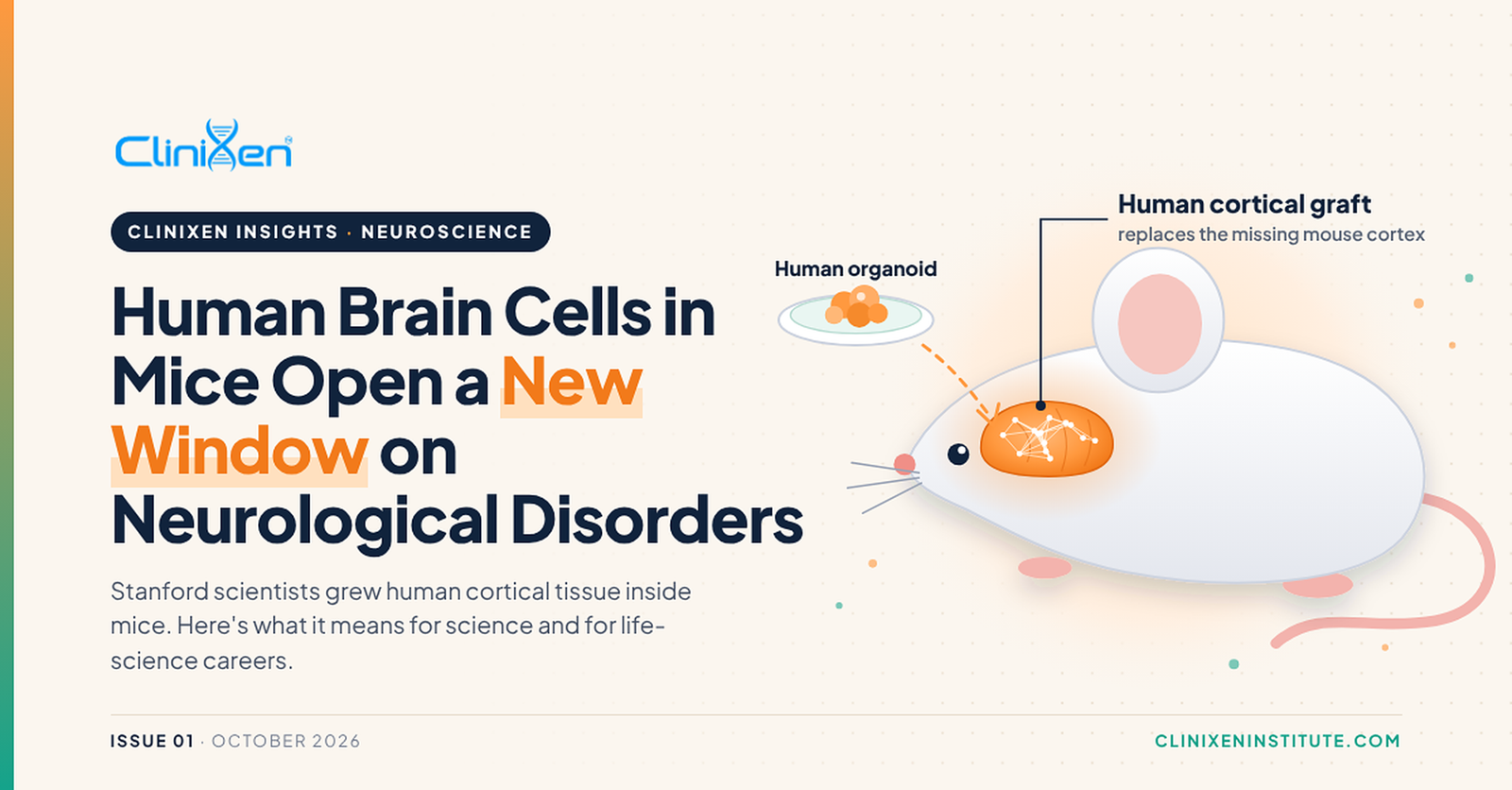
Stanford scientists grew human cortical tissue inside mice. Here’s what it means for science and for life-science careers.
Neurological disorders affect hundreds of millions of people, and many of them begin while the brain is still developing. The hard part for researchers has always been access, because you can’t study a living, developing human brain directly.
Until now, scientists have had two imperfect tools:
- Animal brains are alive and connected, but they aren’t human.
- Lab-grown human “mini-brains” (organoids) are human, but they have no blood supply, no senses and no body to control.
A new study from Stanford University, published in Nature, brings the two together.
What the scientists did
The team, led by Prof. Sergiu P. Pașca of the Stanford Brain Organogenesis Program, used a four-step approach:
- Make room. Mice were genetically engineered so the cells meant to form the neocortex die early. These “apallial” mice lack the neocortex and hippocampus (about half their brain volume), yet they still walk fairly normally.
- Grow human cortex. Human stem cells were grown in the lab into cortical organoids, small 3D clusters of developing human brain tissue.
- Transplant. The organoids were placed into the empty cortical space of newborn mice. The team calls this xenocortication.
- Grow and wire up. Over weeks to months, the human tissue grew a blood supply, filled the space and connected with the mouse brain.
Why clear the space first? Human neurons develop at least 20 times slower than mouse neurons. In earlier attempts, the fast-maturing mouse cells claimed all the connections first.
By the numbers
- ~4 million human cortical neurons placed where about 14 million mouse neurons would have been
- 4.7× growth of the human graft by month three
- 92% of the empty cortical space filled by human tissue
- ~6 months: the age of the human cells when the experiments were stopped
Five results that stood out
- Rare human cell types appeared. The graft produced layer 5 extratelencephalic neurons. Dish-grown organoids rarely make these cells, which are related to cells linked with social behaviour and to cells that are vulnerable in frontotemporal dementia.
- Two-way wiring. Human nerve fibres reached deep into the mouse brain and down to the spinal cord, and mouse brain regions sent connections back.
- Brain-wave-like activity. The human tissue fired in synchronised bursts like those seen in early human brain development, in step with the mouse’s facial movements.
- Memory partly restored. In a maze-based working-memory test, mice without a cortex chose at chance. Grafted mice chose better than chance.
- A working injury model. After a period of low oxygen, which mimics the injury that can cause cerebral palsy, grafted mice developed walking problems. Regular mice did not.
Why it matters for patients
The model is best suited to conditions that begin during early brain development:
- Cerebral palsy: understanding injury around birth and testing protective therapies
- Intellectual disability and epileptic encephalopathies: watching human neurons mature and connect in a living circuit
- Autism: advocates called the work a step toward precision medicine, because grafts can be grown from an individual’s own cells
- Drug testing: trying candidate drugs on human tissue inside a living body before clinical trials
A reality check
- It is not a “human brain in a mouse.” The team describes it as a research model.
- The structure is incomplete. The human neurons did not form the typical layered cortex.
- The clocks don’t match. Mice mature in weeks, while human brain tissue takes years.
The ethics question
The team consulted ethicists, patient advocates, philosophers and legal scholars over several years. Experiments were stopped before the human cells formed a connection considered a hallmark of consciousness. Experts such as Duke’s Nita Farahany say the field still needs clear rules for these “gray areas”, especially if the method moves to larger animals.
Career Connect: where this science needs you
A discovery like this doesn’t stop at the microscope. Each stage needs trained professionals:
- Bioinformatics (Genomics): using sequencing data to identify the cell types a graft produces
- Computational Biology: modelling neural activity and turning data into testable predictions
- Clinical Research & CDM: running trials when neuro-therapies reach patients
- Pharmacovigilance: monitoring the safety of every new neurological drug
- Clinical SAS, R & Python: turning trial data into regulatory submissions
Learn online with CliniXen
CliniXen Institute's 6-month online offers Advanced PG Diplomas in all of these areas. The programmes include industry-oriented training, hands-on projects and live mentor-led classes. Also read our clinical research career guide for India.
Advanced PG Diploma in Clinical Research & Pharmacovigilance
References
- Pașca S.P. et al. Developmental xenocortication using human-derived organoids in mice. Nature (2026).
- Stanford Medicine: Stanford Medicine team creates advanced model for studying brain development, disorders (September 2026). https://med.stanford.edu/news/all-news/2026/09/model-to-study-brain-development.html
- PsyPost (26 September 2026).
- NPR (16 September 2026).
Disclaimer: This article is for educational purposes and summarises publicly available scientific research at the time of writing. It is not medical advice. Findings may be updated as further research is published; always consult the original publications.