Every medicine you can buy at a pharmacy once had to pass through a clinical trial.
Behind each trial sits a long, carefully controlled chain of work: a written plan, regulatory and ethics approvals, sites that enrol patients, and a data team that turns thousands of patient visits into one clean, locked dataset.
This guide walks through the clinical trial life cycle, from the protocol to database lock. It is written for B.Pharm, M.Pharm, Pharm.D, life-science and medical graduates who want to understand how trials really run before choosing a career in clinical research or clinical data management.
1. The Clinical Trial Life Cycle at a Glance
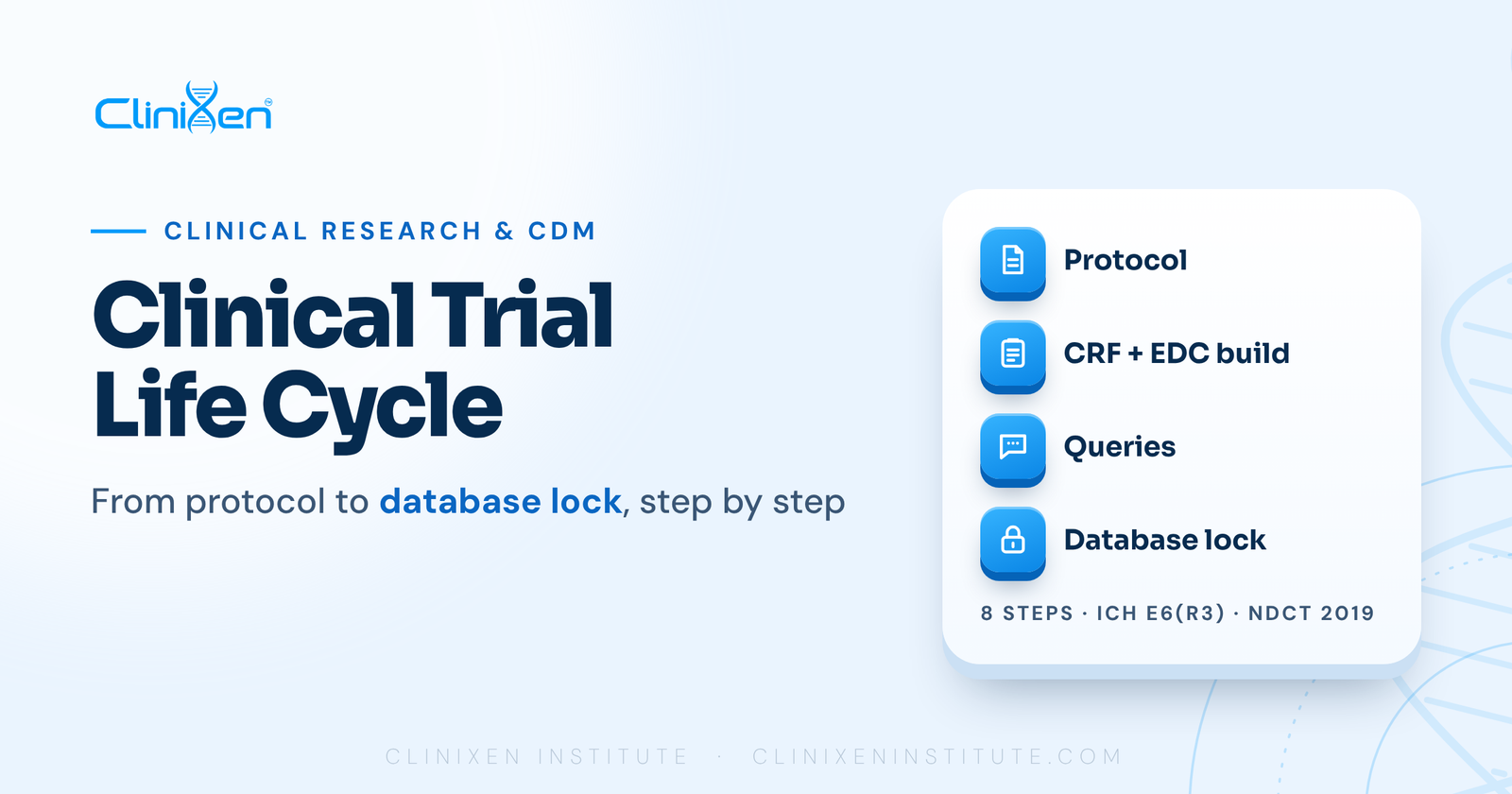
A clinical trial follows a structured sequence of activities. The first three stages establish the trial, while the next five focus on collecting, checking and preparing reliable clinical data for analysis.
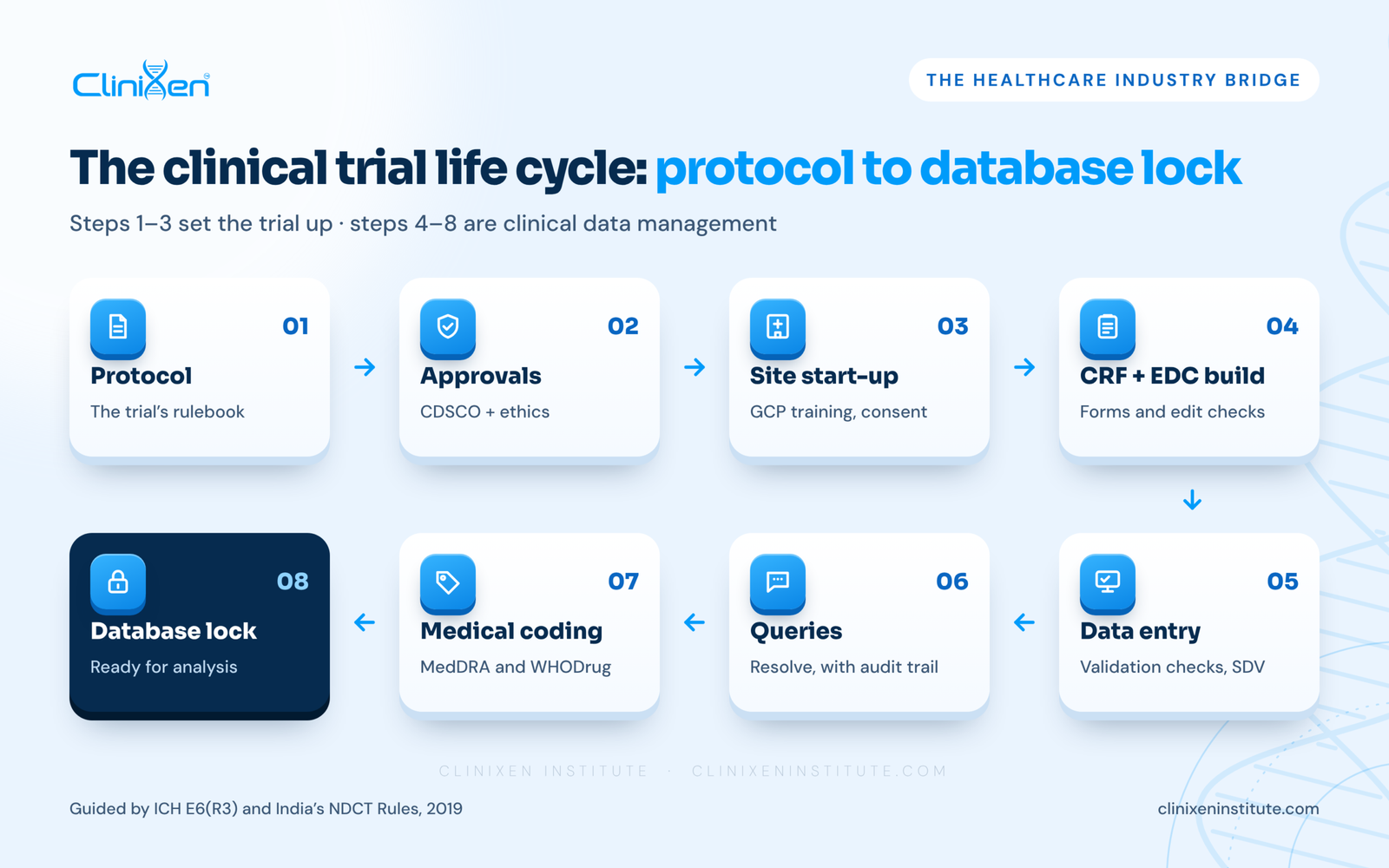
Steps 1 to 3 set the trial up; steps 4 to 8 are clinical data management, ending in a locked dataset ready for analysis.
2. The Four Phases of Clinical Trials
A new medicine moves through four phases of human testing. Each phase answers a different question, and each runs through the same life cycle described below.
| Phase | Main Question | Who Takes Part? |
|---|---|---|
| Phase I | Is it safe, and at what dose? | A small group, often healthy volunteers |
| Phase II | Does it work, and what are the side effects? | Several hundred patients |
| Phase III | Is it better than or as good as standard care? | Hundreds to thousands of patients |
| Phase IV | What happens in real-world use after approval? | Large patient populations |
3. Step 1: Writing the Protocol
The protocol is the trial’s rulebook. Written by the sponsor (usually a pharmaceutical company), it sets out the objective, who can join (inclusion and exclusion criteria), the visit schedule, the endpoints to be measured and how the data will be analysed.
Everything that follows is built from the protocol. The case report form collects exactly the data it asks for, and monitors check sites against it. That is why protocol amendments are formally reviewed and approved.
Alongside the protocol, the sponsor prepares the Investigator’s Brochure, which summarises what is already known about the drug, and the informed consent form that explains the trial to patients in plain language.
4. Step 2: Approvals Under the NDCT Rules, 2019
In India, clinical trials are governed by the New Drugs and Clinical Trials Rules, 2019, notified on 19 March 2019 and administered by the Central Drugs Standard Control Organisation (CDSCO).
A trial needs permission from the Central Licensing Authority (CDSCO, headed by the DCGI) and approval from a registered ethics committee at each site.
The Rules set clear review timelines. For a drug discovered or developed in India, CDSCO decides within 30 working days, and silence counts as deemed approval. For other trials, including global studies, the timeline is 90 working days.
5. Step 3: Site Start-up and ICH-GCP E6(R3)
Once approved, the sponsor or its contract research organisation (CRO) selects and trains sites. Investigators, clinical research coordinators (CRCs) and monitors (CRAs) are briefed on the protocol, and the first patient is screened only after informed consent.
All of this follows Good Clinical Practice. The current standard, ICH E6(R3), was adopted by ICH on 6 January 2025. Its principles and Annex 1 took effect in the EU on 23 July 2025.
It asks teams to focus on quality by design and on the data that matter most, using a risk-proportionate approach. Read our ICH E6(R3) explainer for what changed for trial teams.
6. Step 4: CRF Design and EDC Build
The case report form (CRF) is where each patient’s trial data is recorded: vital signs, lab results, medications and adverse events. Data managers design it from the protocol, so it captures everything the analysis needs and nothing it does not.
Today most trials use an electronic data capture (EDC) system. The CRF is built as electronic screens, and edit checks are programmed in.
For example, an alert fires if a date of visit is earlier than the date of consent, or a value falls outside a plausible range.
These rules are written down in a data management plan (DMP). It records how data will be collected, checked, coded and locked, and who is responsible for each task, so the whole team works from one agreed process.
7. Step 5: Data Entry and Validation
Site staff enter data from source documents, such as hospital records, into the EDC. Programmed edit checks flag problems at once. Data managers then run further manual and listing reviews to catch what automated checks miss, like an unusual pattern across visits.
In parallel, monitors (CRAs) visit or remotely review sites. They compare what was entered in the EDC with the original source documents, a step called source data verification.
Under ICH E6(R3), this checking is focused on the data that matter most for patient safety and the trial’s main results, rather than every single field.
8. Step 6: Query Management
When something looks wrong or is missing, the data manager raises a query in the EDC asking the site to check it. The site corrects the value or explains it, and the query is closed.
Every change is captured in an audit trail, so anyone can later see who changed what, when and why.
A trial cannot move toward lock while important queries are still open, so tracking query age and resolution rates is a core data-management task.
9. Step 7: Medical Coding
Investigators describe events in their own words. Coding turns them into standard terms so they can be counted and compared.
- MedDRA: Used for adverse events and medical history.
- WHODrug: Used for medications.
Serious adverse events are also reconciled between the clinical database and the safety database, so both tell the same story.
10. Step 8: Database Lock
Database lock is the finish line of data management. Before it, the team confirms that all data are entered, queries are resolved, coding is complete, SAE reconciliation is done and the investigators have signed off.
Many teams first apply a soft lock, a short freeze in which a final review is done while changes are still possible. When that review is clean, the hard lock follows and editing access is removed.
Once locked, the data can no longer be edited. The locked dataset goes to statisticians for analysis and, finally, into the clinical study report submitted to regulators.
11. Careers Across the Clinical Trial Life Cycle
Every step above is someone’s job. Entry-level roles sit close to the work:
| Role | Where in the Life Cycle | What They Do |
|---|---|---|
| Clinical Research Coordinator | Steps 3, 5 | Runs the trial day to day at the site: consent, visits and source records. |
| Clinical Trial Associate | Steps 2, 3 | Supports start-up, documents and trial master file at the sponsor or CRO. |
| Clinical Data Coordinator | Steps 4 to 8 | Builds checks, reviews data, manages queries and prepares for lock. |
12. Learn the Clinical Trial Life Cycle Hands-on
CliniXen Institute’s Advanced Diploma in Clinical Research follows this exact path. You design a CRF, enter data in an EDC, resolve queries and prepare a dataset for database lock, guided by mentors in live classes.
3–6 months · Live, mentor-led · Placement assistance, not a job guarantee.
Build Practical Skills for a Clinical Research Career
Learn the clinical trial workflow through practical activities covering CRF design, EDC, query management and database lock.
Want to know more? Book a free counselling call or WhatsApp CliniXen at +91 91089 56193.
13. Frequently Asked Questions
What are the main stages of a clinical trial life cycle?
Protocol, regulatory and ethics approvals, site start-up, CRF and EDC build, data entry and validation, query management, medical coding and database lock. The locked data then go to statistical analysis and the clinical study report.
What is database lock in a clinical trial?
It is the point where the trial database is closed to further edits, after all data are entered, queries resolved, coding finished and investigators have signed off.
What is the difference between a CRF and EDC?
The CRF is the form that defines what data are collected for each patient. EDC is the electronic system in which that form is built and the data are entered and checked.
What changed with ICH E6(R3)?
Adopted by ICH in January 2025, it promotes quality by design and a risk-proportionate approach, focusing effort on the data and processes most critical to patient safety and reliable results.
Which law governs clinical trials in India?
The New Drugs and Clinical Trials Rules, 2019, administered by CDSCO. They set approval timelines of 30 working days for drugs developed in India and 90 working days for others.
Can a fresher start a career in clinical data management?
Yes. Pharmacy, life-science and medical graduates commonly start as Clinical Data Coordinators or Clinical Trial Associates after focused training in GCP, CRF design, EDC and query management.
References
- ICH. E6(R3) Guideline for Good Clinical Practice, Step 4, 6 January 2025.
- European Medicines Agency. ICH E6 Good clinical practice: scientific guideline (effective dates).
- Central Drugs Standard Control Organisation (CDSCO) New Drugs and Clinical Trials Rules, 2019, G.S.R. 227(E), 19 March 2019.
- MedDRA: Medical Dictionary for Regulatory Activities.
Disclaimer: This article is for educational purposes only and is not regulatory or legal advice. Regulatory requirements and timelines may change; verify current details with the relevant official source. CliniXen programme placement assistance does not guarantee a job or salary outcome.