If you have ever run a bioinformatics analysis by typing one command after another into a terminal, you already know the problem. One sample works. Fifty samples become a mess of half-finished files, forgotten parameters and scripts nobody can re-run six months later.
That is exactly what workflow managers solve. In 2026, two tools dominate the conversation: Snakemake and Nextflow. Both are open source, both are mature, and both are used in genomics labs and pharma companies around the world. But they think about pipelines very differently.
In this guide, we compare Snakemake vs Nextflow on syntax, scalability, cloud support, community and career value, with real code side by side, so you can decide which one to learn first.
Why Workflow Managers Matter in Bioinformatics
A typical next-generation sequencing (NGS) analysis is not one step. It is quality control, trimming, alignment, sorting, duplicate marking, variant calling and annotation, often repeated across hundreds of samples. A workflow manager lets you describe these steps once and then takes care of the execution.
- Reproducibility: The same inputs and settings give the same outputs, every time.
- Parallelism: Independent samples run at the same time across CPUs, clusters or the cloud.
- Resumability: If step six fails, you fix it and restart from that step instead of starting from scratch.
- Portability: Software environments are packaged with Conda or containers, so the pipeline can run on your laptop, an HPC cluster or AWS.
For anyone aiming for a genomics or computational biology role, knowing at least one workflow manager is a baseline skill.
What Is Snakemake?
Snakemake was created by Johannes Köster and is built on Python. You write a Snakefile made up of rules. Each rule specifies the files it needs as input, the files it produces as output, and the command that transforms one into the other.
Snakemake works backwards from the files you request. It determines which rules must run, in what order, and skips anything that is already up to date. If you have used GNU Make, the concept will feel familiar. If you know Python, the syntax will feel natural.
The current release line is Snakemake 9, with version 9.27.0 reported on PyPI at the time of writing. In March 2026, the community held its second Snakemake Hackathon in Munich. Work from the event included a reorganised command-line interface, a rebuilt software deployment system, an experimental SQLite-based metadata store for large workflows, improved support for workflows hosted on GitHub and GitLab, and updated cluster executor plugins such as SLURM.
What Is Nextflow?
Nextflow started at the Centre for Genomic Regulation (CRG) in Barcelona and is now developed by Seqera. It uses its own Groovy-based language, DSL2. Instead of thinking primarily in files, Nextflow connects processes through channels, allowing data to flow through a pipeline as process inputs become available.
Nextflow uses calendar-style versioning. The latest release reported at the time of writing is v26.10.2. The 26.04 release introduced significant language changes, including strict syntax, records and static typing to catch errors earlier. It also introduced a Nextflow Module Registry with built-in nextflow module commands to search, install and run modules, including nf-core modules.
One of Nextflow's biggest advantages is nf-core, a community project that builds peer-reviewed, ready-to-run pipelines. As of October 2026, nf-core lists 159 pipelines and 2,124 modules.
Snakemake vs Nextflow: The Same Step, Side by Side
The fastest way to understand the difference is to see the same task in both tools. The following examples align paired-end reads with BWA and sort the output with samtools, assuming the reference genome is already indexed.
Snakemake (Snakefile)
rule align:
    input:
        r1="reads/{sample}_R1.fastq.gz",
        r2="reads/{sample}_R2.fastq.gz",
        ref="ref/genome.fa"
    output:
        "bam/{sample}.sorted.bam"
    threads: 8
    conda:
        "envs/align.yaml"
    shell:
        "bwa mem -t {threads} {input.ref} {input.r1} {input.r2} "
        "| samtools sort -o {output}"
Nextflow (main.nf)
process ALIGN {
    cpus 8
    conda 'bioconda::bwa bioconda::samtools'

    input:
    tuple val(sample), path(reads)
    path ref

    output:
    tuple val(sample), path("${sample}.sorted.bam")

    script:
    """
    bwa mem -t ${task.cpus} ${ref} ${reads} | samtools sort -o ${sample}.sorted.bam
    """
}

workflow {
    reads = channel.fromFilePairs('reads/*_R{1,2}.fastq.gz')
    ALIGN(reads, file('ref/genome.fa'))
}
Notice the difference in mindset. In Snakemake, the {sample} wildcard in file names drives the workflow. Ask for bam/patient01.sorted.bam, and Snakemake works out which rules must run. In Nextflow, you build a channel of read pairs and push it through the ALIGN process.
Snakemake is file-first; Nextflow is data-flow-first.
Head-to-Head Comparison
| Feature | Snakemake | Nextflow |
|---|---|---|
| Language | Python-based rules | Groovy-based DSL2, with strict syntax in 26.x |
| Core idea | File-based; works backwards from target files | Dataflow; processes connected by channels |
| Learning curve | Gentle if you know Python | Steeper initially because of new DSL concepts |
| Resume failed runs | Reruns only outdated or missing outputs | Supports -resume and task caching |
| Software environments | Conda, Apptainer/Singularity and containers | Conda, Docker, Apptainer/Singularity and Wave |
| HPC clusters | Executor plugins, including SLURM and HTCondor | Built-in executors for SLURM, PBS, SGE, LSF and more |
| Cloud | Executor and storage plugins | Native integrations for AWS Batch, Google Batch, Azure Batch and Kubernetes |
| Ready-made pipelines | Snakemake Workflow Catalog | nf-core: 159 pipelines and 2,124 modules |
| Commercial platform | No commercial platform required | Optional Seqera Platform for monitoring |
| Best suited for | Academic labs, Python users and custom analyses | Production pipelines, cloud-scale workflows and pharma |
Scalability, HPC and Cloud
Both tools can scale from a laptop to thousands of jobs. The real question is not simply whether a tool can scale, but where you plan to run your workflows.
Snakemake has moved its cluster and cloud support into executor plugins. This keeps the core small and allows individual plugins to be maintained by people familiar with each system. For university HPC clusters running SLURM, Snakemake can be a comfortable fit.
Nextflow was designed with cloud execution in mind. Switching from a local run to AWS Batch or Google Batch is largely a configuration change, and container support is deeply integrated. This is one reason many pharma and biotech teams standardise on Nextflow for production pipelines.
Performance depends far more on your tools, data size and infrastructure than on the workflow manager itself. In practice, the overhead of either tool is small compared with the time spent in aligners and variant callers. Choose based on fit, not raw speed.
Community and Ecosystem
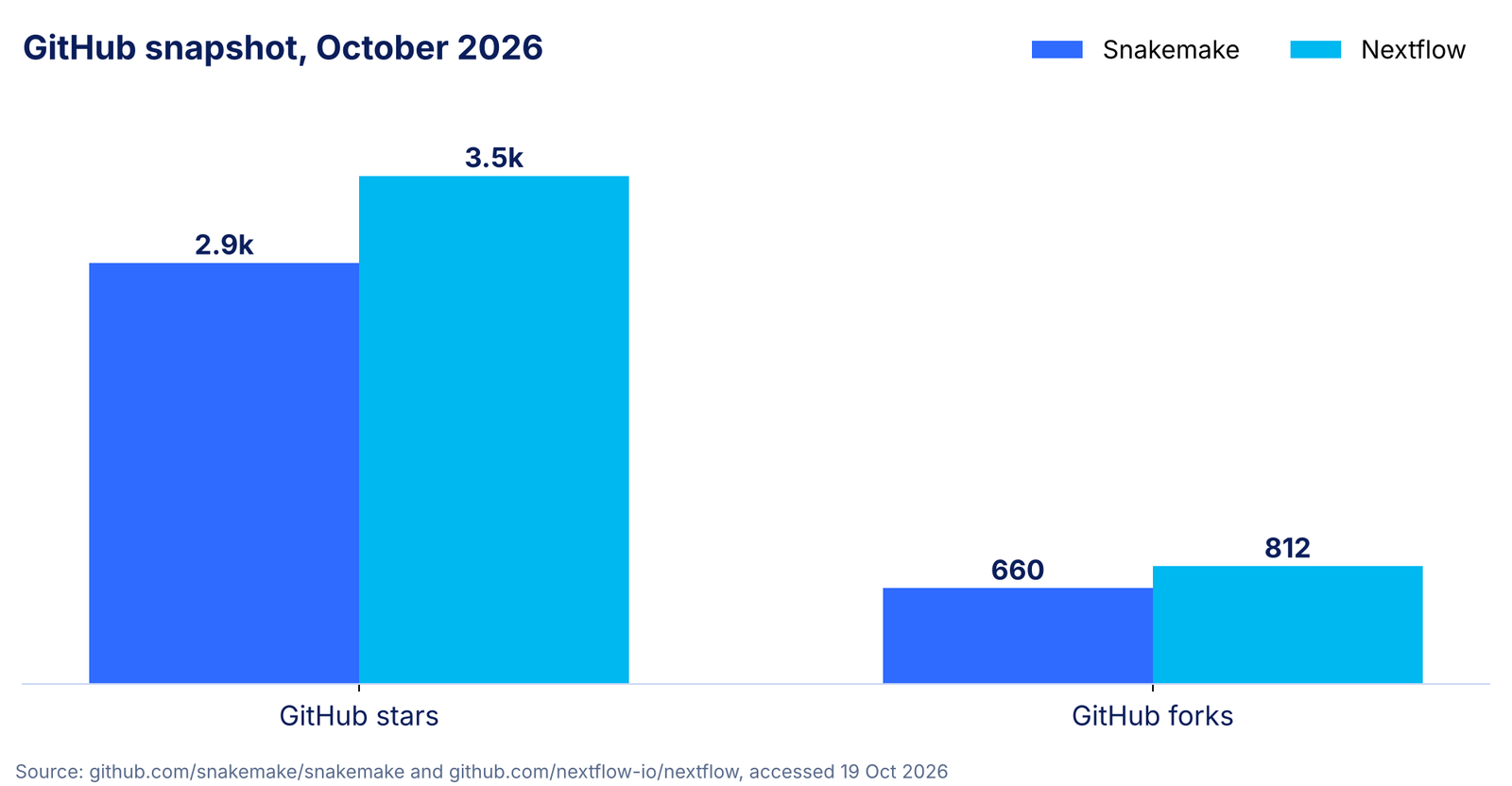
Both projects are actively developed. On GitHub, Nextflow had approximately 3.5k stars and 812 forks, while Snakemake had approximately 2.9k stars and 660 forks, according to the figures checked on 19 October 2026.
Stars are only part of the story. Nextflow's major ecosystem advantage is nf-core. If you need an RNA-seq, variant-calling or single-cell pipeline, there is a good chance a tested pipeline already exists.
Snakemake's strength is the large Python ecosystem around it. This makes it convenient to combine workflows with pandas, plotting libraries and machine learning code.
Which One Should You Learn in 2026?
There is no single winner. The right choice depends on your programming background, research environment and career goals.
Choose Snakemake if you...
- Already know Python or are just starting out with programming.
- Work in an academic lab on a university HPC cluster.
- Build custom analyses that change frequently and integrate with Python data science code.
Choose Nextflow if you...
- Want to work in pharma, biotech or a large sequencing facility.
- Plan to run pipelines on AWS, Google Cloud or Azure.
- Want to use or contribute to nf-core pipelines.
Our advice: Learn the core concepts once, and the second tool becomes much easier. Start with whichever matches your current language and environment, then pick up the other. Many job descriptions list both tools, and demonstrating that you understand reproducible pipelines matters more than which syntax you learned first.
Learn Workflow Managers with CliniXen
Workflow managers build on two core skills: Linux and Python. Without them, Snakemake and Nextflow can feel like magic. With them, they become tools you can understand, control and troubleshoot.
The CliniXen Genomics PG Diploma builds this foundation, from Linux and Python to NGS analysis and variant calling, with hands-on projects you can demonstrate to employers. If you are more interested in protein structure and drug design, explore the Advanced Diploma in Bioinformatics – Structural Biology & Computational Drug Discovery.
Advanced Diploma in Bioinformatics – Specialization in Genomics & NGS Data Analysis
Build your foundation in bioinformatics and reproducible genomics workflows.
Explore the Computational Biology PG Diploma if your interests lean towards protein structure and drug design.
Ready to build real pipelines? Explore the Genomics PG Diploma, explore the Computational Biology PG Diploma, or book a free counselling session to find the right learning path.
Frequently Asked Questions
Is Snakemake or Nextflow better for beginners?
Snakemake is usually easier for beginners who already know some Python because its rules read like Python code. Nextflow has a steeper start, but its dataflow model becomes powerful once you understand it.
Do I need to know Groovy to use Nextflow?
No. You need to learn the Nextflow language, which is based on Groovy, but you do not need to learn general Groovy programming. Most pipeline code uses a small set of patterns.
Can Snakemake run on the cloud?
Yes. Snakemake supports cloud and cluster execution through executor and storage plugins. Nextflow's cloud integrations are more built-in, which is one reason it is popular with cloud-first teams.
What is nf-core?
nf-core is a community project that builds peer-reviewed, ready-to-use Nextflow pipelines and modules. As of October 2026, it lists 159 pipelines and 2,124 modules.
Should I learn both Snakemake and Nextflow?
Eventually, yes. Learn one well first. The core ideas, including rules or processes, inputs and outputs, software environments and resuming failed runs, transfer directly to the other tool.
Further Reading
- Mölder F. et al. (2021). Sustainable data analysis with Snakemake. F1000Research. Read the paper.
- Di Tommaso P. et al. (2017). Nextflow enables reproducible computational workflows. Nature Biotechnology. Read the paper.
- nf-core pipelines. Browse nf-core pipelines.
- Snakemake Hackathon 2026. Technical University of Munich, MDSI. Visit TUM MDSI.
Disclaimer: This article is for educational purposes and reflects publicly available scientific information and software documentation at the time of writing. Software versions, features and community statistics may change. Always check the latest official documentation before using a tool in a research or production workflow.