One of the most common questions learners ask is: Which tool should I learn first? The honest answer is that it depends on the career track you want to pursue. A clinical data professional, regulatory affairs associate, clinical programmer and bioinformatics analyst do not use the same tools every day.
Life sciences has a wide ecosystem of software, databases and technical standards. Some tools help capture clinical trial data, others organise regulatory submissions, analyse clinical datasets or explore biological sequences and protein structures.
This edition of the CliniXen Career Toolkit maps the tools used across four career tracks, explains what they do in plain language, shows where they fit into drug development and gives you a practical 30-minute exercise to try.
1. The Life Sciences Career Toolkit: Four Tracks
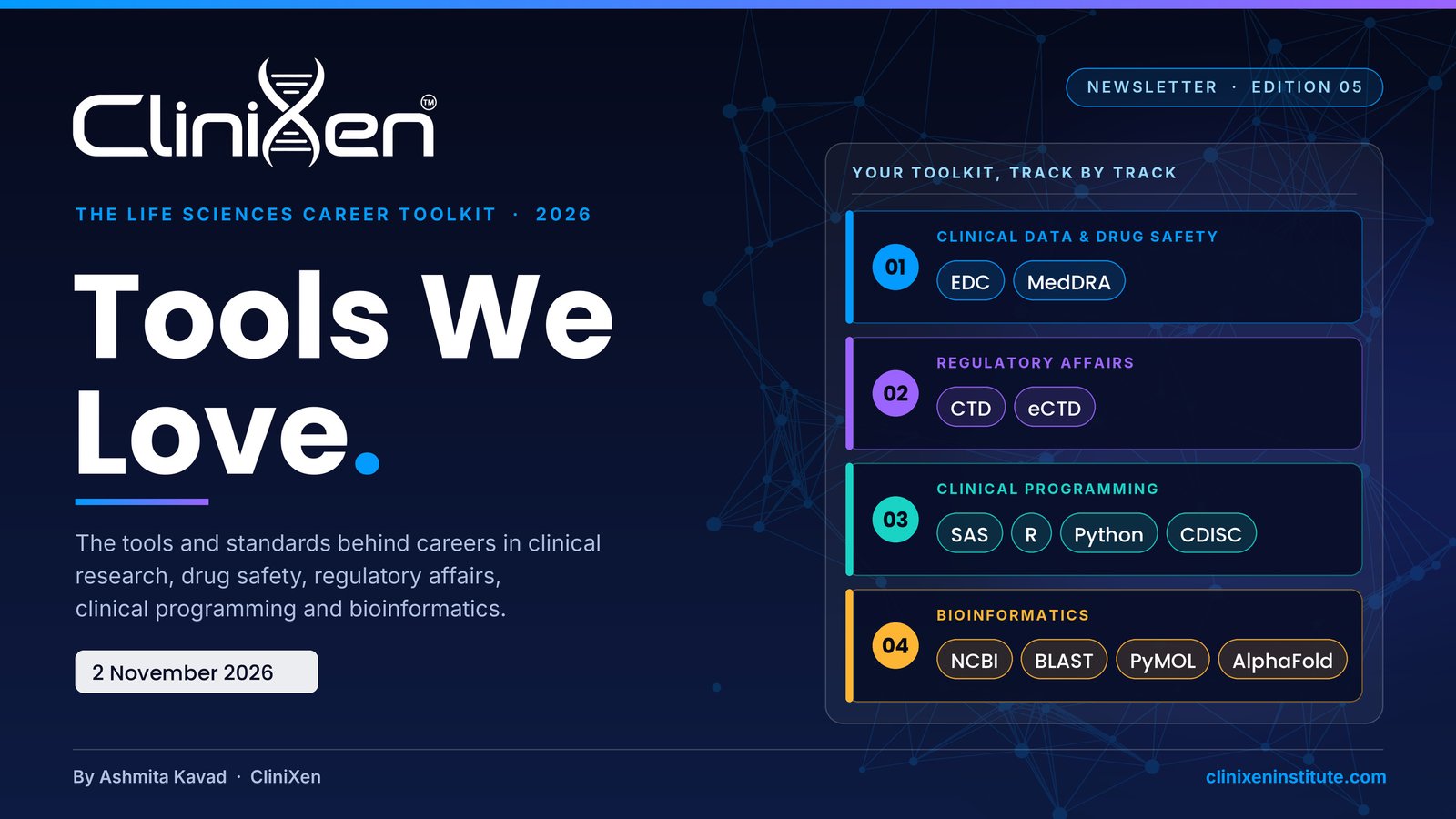
Here are the four areas covered in this guide:
- Clinical Data & Drug Safety: Electronic Data Capture (EDC) and MedDRA.
- Regulatory Affairs: Common Technical Document (CTD) and electronic CTD (eCTD).
- Clinical Programming: SAS, R and Python, together with CDISC SDTM and ADaM.
- Bioinformatics: NCBI, BLAST, AlphaFold Database and PyMOL.
You do not need to learn every tool at once. Start with the standards and tools that match the work you want to do, then build your skills through practical exercises.
2. How the Tools Connect
Think of the life sciences workflow as two connected journeys.
From clinical trial data to regulatory submission
Clinical trial information is captured by site teams using EDC systems. Adverse events and medical terminology can be coded using MedDRA. Clinical programmers work with standardised datasets such as SDTM and ADaM, while regulatory professionals organise the evidence into a CTD or eCTD submission.
From biological data to a 3D structure
Bioinformatics follows another path. Researchers can retrieve biological sequences from NCBI, compare them using BLAST, explore predicted protein structures through the AlphaFold Database and visualise molecular structures using PyMOL.
Each tool has a specific purpose. Understanding how information moves between them is often more valuable than simply memorising software names.
3. Track 01: Clinical Data & Drug Safety
Tool 1: Electronic Data Capture (EDC)
Electronic Data Capture systems replace paper-based Case Report Forms (CRFs) with electronic CRFs, commonly called eCRFs. During a clinical trial, site teams enter participant information into these systems.
EDC platforms help clinical data teams manage information through features such as:
- Electronic forms for capturing clinical trial data.
- Edit checks that identify missing, inconsistent or out-of-range values.
- Audit trails that record changes and maintain data traceability.
- Queries that help resolve data discrepancies with trial sites.
Examples of EDC platforms include Medidata Rave, Oracle Clinical One and Veeva Vault CDMS.
Why it matters: Clinical trial data must be reliable and traceable. The final ICH E6(R3) Good Clinical Practice guideline was released in January 2025, with the EU implementation effective from July 2025. Its data-integrity principles include ALCOA: attributable, legible, contemporaneous, original and accurate.
Your 30-minute exercise
Sketch a simple 10-field Case Report Form for a participant's blood pressure visit. Include three edit checks, such as a check for missing values, an acceptable range for systolic blood pressure and a consistency check between systolic and diastolic readings.
Tool 2: MedDRA
MedDRA stands for Medical Dictionary for Regulatory Activities. It is a standard medical terminology used to code information such as adverse events, medical history and indications in clinical research and drug safety.
MedDRA uses a five-level hierarchy:
- SOC: System Organ Class
- HLGT: High Level Group Term
- HLT: High Level Term
- PT: Preferred Term
- LLT: Lowest Level Term
MedDRA was developed under the ICH framework and is maintained by the Maintenance and Support Services Organization (MSSO). It is regularly updated.
Consistent coding is important for electronic Individual Case Safety Reports (ICSRs) submitted to regulators across ICH regions. It also supports the review of safety information and signal detection. Teams should specify the MedDRA version used when coding data.
Your 30-minute exercise
Practise coding five sample events: “felt dizzy after dose”, rash, vomiting, headache and raised liver enzymes. Explore how everyday descriptions map to standard medical terminology.
Relevant CliniXen tracks: Clinical Research & Clinical Data Management; Clinical Research & Pharmacovigilance.
4. Track 02: Regulatory Affairs
Tool 3: CTD and eCTD
The Common Technical Document (CTD) is an ICH-harmonised structure used to organise information in a marketing application for a medicine. It brings quality, non-clinical and clinical evidence together in a consistent format.
The CTD is organised into five modules:
- Module 1 – Regional Administrative Information: Administrative and prescribing information specific to the regulatory region.
- Module 2 – Summaries: Summaries and overviews of the quality, non-clinical and clinical information.
- Module 3 – Quality: Information about the drug substance, drug product and manufacturing quality.
- Module 4 – Non-clinical Study Reports: Non-clinical and pharmacological/toxicological study information.
- Module 5 – Clinical Study Reports: Clinical study information and reports.
eCTD is the electronic submission format used to submit and manage this dossier electronically. It supports the organisation and lifecycle management of regulatory submissions.
What is changing? Regulatory agencies are moving towards eCTD v4.0. The FDA has accepted new applications using eCTD v4.0 since September 2024 while continuing to support v3.2.2. The EMA made v4.0 optional for new centralised marketing authorisation applications from December 2025. Japan's PMDA has reported a requirement for v4.0 from April 2026.
These timelines can change and may differ by submission type and agency. Always verify the latest technical requirements directly with the relevant regulator before preparing a submission.
Your 30-minute exercise
Make a list of the documents that could appear in CTD Modules 2–5. Then identify which documents or sections a medical writer might draft or coordinate with subject-matter experts.
Relevant CliniXen track: Clinical Research, Regulatory Affairs & Medical Writing.
5. Track 03: Clinical Programming
Tool 4: CDISC SDTM and ADaM
CDISC standards help make clinical research data more consistent and easier to review. Two important standards in clinical programming are SDTM and ADaM.
- SDTM – Study Data Tabulation Model: Provides standard structures, known as domains, for organising and tabulating clinical trial data.
- ADaM – Analysis Data Model: Provides analysis-ready datasets that support statistical analysis and traceability back to SDTM data.
ADaM datasets are required in new drug and biologics applications submitted to the US FDA. CDISC controlled terminology is refreshed roughly every six months. However, the latest published CDISC version is not automatically the version accepted by a regulator.
For FDA submissions, teams should check the FDA Study Data Standards Catalog to confirm which versions are accepted for the relevant application.
Tools 5, 6 and 7: SAS, R and Python
Clinical programmers use programming languages to prepare, transform, validate and analyse clinical trial datasets. The choice of language depends on the organisation, project requirements and regulatory context.
- SAS: A long-standing tool in clinical programming and submission-oriented statistical programming. It is widely used for clinical datasets and tables, listings and figures (TLFs).
- R: An open-source language used for statistical analysis, visualisation and clinical data workflows. The pharmaverse ecosystem includes the
admiralpackage, an ADaM in R Asset Library developed by teams at Roche and GSK. - Python: Used for data analysis, automation and general programming. Its pandas library is widely used for working with structured datasets.
Many teams use a combination of these languages. Understanding the data flow from collection to standardisation and analysis is more important than relying on one language alone.
Important: The admiral package provides tools for building ADaM datasets in R. Using it does not automatically create a compliant, finished dataset. The programmer still needs to understand the standards, specifications, validation and project requirements.
Your 30-minute exercise
Install R, the admiral package and pharmaversesdtm. Follow an ADSL tutorial using the bundled test data. Trace selected variables back to their SDTM sources and understand how the analysis dataset is built.
Relevant CliniXen track: Clinical SAS, R Programming & Python. Topics include Base and Advanced SAS, CDISC SDTM/ADaM, TLF generation, R tidyverse and admiral, and Python pandas.
6. Track 04: Bioinformatics
Tool 8: NCBI and BLAST
The National Center for Biotechnology Information (NCBI) hosts public biological databases and resources, including RefSeq. Researchers use these resources to retrieve and investigate biological information.
BLAST, or Basic Local Alignment Search Tool, compares a nucleotide or protein sequence against sequences in a database to find regions of local similarity.
One important BLAST result is the E-value. It estimates how likely a match of a given score could occur by chance in a database search. A lower E-value generally indicates a more statistically significant match.
Remember: BLAST measures sequence similarity or identity. Homology refers to an evolutionary relationship and is inferred from evidence; it is not a percentage measurement.
Your 30-minute exercise
Download a human protein FASTA sequence from NCBI Protein. Run a BLASTp search against RefSeq and compare the top three hits by E-value and percentage identity.
Tool 9: AlphaFold Database
The AlphaFold Protein Structure Database, developed through work involving EMBL-EBI and Google DeepMind, provides predicted 3D protein structures. Its sixth release contains more than 241 million predicted structures.
These predictions help researchers form and investigate biological hypotheses, but they do not replace experimental evidence. Two confidence measures are particularly useful:
- pLDDT: A per-residue confidence score indicating confidence in the local structure prediction.
- PAE: Predicted Aligned Error, which helps assess confidence in the relative positions of parts of a predicted structure.
A single predicted structure may not capture every biological state, interaction or protein complex. Interpret confidence information alongside the research question and available experimental evidence.
Tool 10: PyMOL
PyMOL is a molecular visualisation tool used to explore and display 3D protein structures and other biomolecules. Researchers can use it to inspect active sites, mutations and potential drug-binding pockets, and to prepare publication-quality molecular images.
PyMOL also supports Python-based scripting and plugins for tasks such as docking and sequence analysis. It is developed by Schrödinger, and users should check the applicable licence before using it.
Your 30-minute exercise
Open a protein entry in the AlphaFold Database and review its confidence information. Load a related PDB structure in PyMOL, colour it by chain, display a ligand as sticks and measure the distance between selected atoms. Then try scripting the same steps so you can repeat the visualisation.
Relevant CliniXen tracks: Bioinformatics – Genomics & NGS Data Analysis; Bioinformatics – Structural Biology & Computational Drug Discovery.
7. Where Should You Start?
The best starting point depends on the kind of work you enjoy. Use this guide to choose a first learning direction.
| Your Interest | Start With | Then Explore |
|---|---|---|
| Accuracy and patient safety | EDC & MedDRA | CDISC SDTM, then ICSR concepts |
| Science, structure and writing | CTD/eCTD | ICH guidelines and MedDRA basics |
| Logic and coding | SDTM and ADaM | R with admiral, SAS or Python |
| Biology and data | NCBI and BLAST | AlphaFold Database, then PyMOL |
8. Three Takeaways to Remember
- Learn the standard before the software. Understanding what a CRF, SDTM domain, CTD module or protein sequence represents gives you a stronger foundation for using the tools.
- Match the tool to the question. EDC captures clinical data, MedDRA standardises medical terminology, BLAST compares sequences and PyMOL visualises molecular structures. Each tool solves a different problem.
- Verify time-sensitive details at the source. Software versions, controlled terminology, submission formats and regulatory effective dates change. Check official sources before relying on an older guide or tutorial.
9. Jargon Buster
| Term | Meaning |
|---|---|
| CRF | Case Report Form – a form used to collect clinical trial participant data. |
| Edit Check | A programmed check that identifies missing, inconsistent or out-of-range data. |
| Query | A request to clarify or correct a data discrepancy. |
| ICSR | Individual Case Safety Report – a report containing information about an individual suspected adverse reaction. |
| TLF | Tables, Listings and Figures – outputs used to present clinical trial results. |
| Dossier | A structured collection of documents and evidence submitted to a regulatory authority. |
| E-value | A BLAST statistic estimating the number of matches of a given score expected by chance. |
| pLDDT | A confidence score used to assess local accuracy in an AlphaFold structure prediction. |
10. Where CliniXen Fits
Choosing a career track is the first step. The next is building practical knowledge through structured learning, exercises and projects.
CliniXen offers programmes across the career areas covered in this toolkit:
- Clinical Research & Clinical Data Management
- Clinical Research & Pharmacovigilance
- Clinical Research, Regulatory Affairs & Medical Writing
- Bioinformatics – Genomics & NGS Data Analysis
- Bioinformatics – Structural Biology & Computational Drug Discovery
- Clinical SAS, R Programming & Python
Depending on the programme, learning support includes hands-on projects, mock interviews, ATS-friendly resume guidance and placement assistance. Placement assistance is support during the job-search process; it is not a guarantee of employment.
Build Practical Skills for a Life Sciences Career
Explore learning paths in clinical research, clinical data management, pharmacovigilance, regulatory affairs, medical writing, clinical programming and bioinformatics.
Not sure which track is right for you? Book a free counselling call or WhatsApp CliniXen at +91 91089 56193 to discuss your learning interests and possible programme options.
11. Frequently Asked Questions
Which life sciences tool should I learn first?
Start with the tools that match your intended career track. For clinical data and drug safety, explore EDC and MedDRA. For regulatory affairs, begin with CTD/eCTD. For clinical programming, understand SDTM and ADaM. For bioinformatics, start with NCBI and BLAST.
Do I need to learn all these tools to work in life sciences?
No. Different roles use different tools. A clinical data professional does not need the same technical toolkit as a bioinformatics analyst. Focus on the standards and tools relevant to your chosen area.
What is the difference between SDTM and ADaM?
SDTM organises clinical trial data into standard tabulation domains. ADaM provides analysis-ready datasets that support statistical analysis and traceability back to SDTM data.
Are SAS, R and Python interchangeable?
They are programming languages used for different but sometimes overlapping tasks. SAS has a long history in clinical programming, R is widely used for statistics and analysis, and Python is used for data analysis and automation. The language required depends on the role and project.
Is an AlphaFold prediction the same as an experimentally determined structure?
No. AlphaFold provides predicted protein structures and confidence information. Predictions can support research hypotheses, but they do not replace experimental evidence. Confidence measures such as pLDDT and PAE should be considered when interpreting a prediction.
Can beginners learn bioinformatics tools such as BLAST and PyMOL?
Yes. Learners can begin with biological sequence databases and basic sequence comparison, then progress to protein structure exploration and molecular visualisation. A foundation in biology and a willingness to practise are useful starting points.
Does CliniXen provide placement assistance?
CliniXen programme support may include mock interviews, ATS-friendly resume guidance and placement assistance. Placement assistance does not guarantee a job or a particular salary outcome.
References
- CITI Program. ICH releases final version of E6(R3) Good Clinical Practice Guideline. Read source.
- Medrio. ICH E6(R3) explained. Read source.
- CASRAI. MedDRA – Medical Dictionary for Regulatory Activities. Read source.
- IntuitionLabs. eCTD software and FDA, EMA and Health Canada requirements. Read source.
- RAPS (3 February 2026). FDA and EMA officials encourage companies to pilot eCTD 4.0. Read source.
- IntuitionLabs. CDISC SDTM and ADaM guide. Read source.
- IntuitionLabs. FDA Study Data Standards version and rejection matrix. Read source.
- Certara. Three CDISC standards converging in 2026: how to stay ahead. Read source.
- pharmaverse. admiral documentation. Read source.
- PHUSE. R package to make ADaM handling easier. Read source.
- NCBI Bookshelf. BLAST: Basic Local Alignment Search Tool. Read source.
- PubMed Central. Sequence comparison: similarity versus homology. Read source.
- EMBL-EBI. AlphaFold Database release notes. Read source.
- Nucleic Acids Research (2024). AlphaFold Protein Structure Database updates. Read source.
- FEBS Network. AlphaFold protein structure predictions: a step change for biology. Read source.
- Biomolecules (2022). PyMOL plugins for molecular visualisation and analysis. Read source.
Disclaimer: This article is for educational purposes only and is not medical, clinical or regulatory advice. Tool names are provided as examples and do not represent endorsements. Software capabilities, standards, versions and regulatory timelines may change; verify current details with the relevant official source. CliniXen programmes and placement assistance do not guarantee a job or salary outcome.