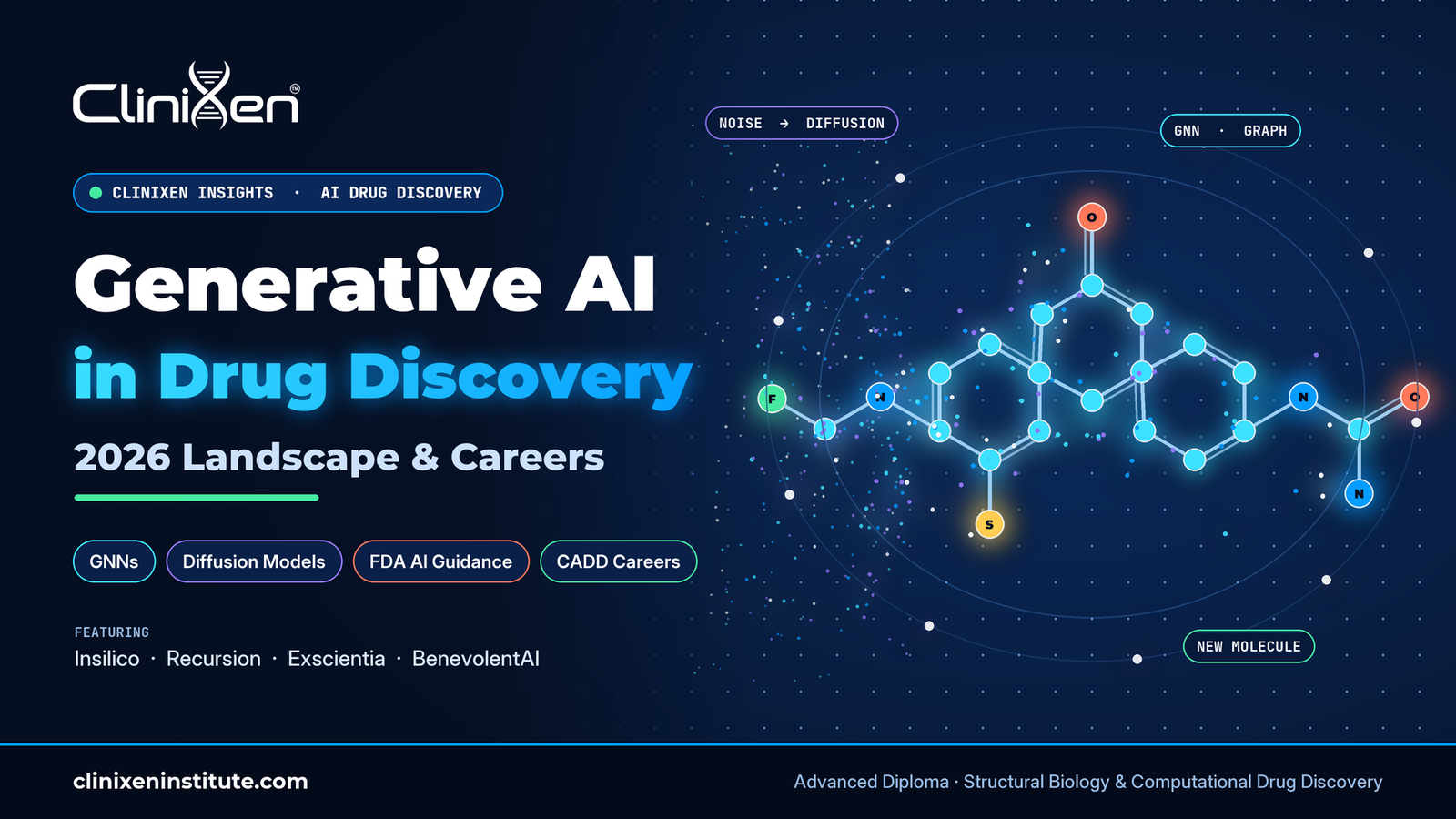
Bringing one new medicine to patients still takes 10 to 15 years and, by the widely cited Tufts CSDD estimate, more than US$2 billion. Worse, roughly 9 out of 10 drug candidates that enter clinical trials fail. That is the problem generative AI is now attacking, and in 2026 it is no longer a slide-deck promise.
AI-designed molecules are in human trials, regulators have published guidance on AI models, and pharmaceutical companies are hiring people who can speak both biology and machine learning.
In this guide, we explore what AI drug discovery in 2026 actually looks like: the models doing the work, the companies leading it, what the US FDA expects, and the career paths opening up for life-science, pharmacy and chemistry graduates in India.
1. What Is Generative AI in Drug Discovery?
Classic machine learning in pharma was mostly predictive: give it a molecule and it estimates a property, such as solubility, toxicity or binding strength. Generative AI flips the question. You describe the properties you want, and the model proposes new molecules or proteins that have never existed. Predictive models then score and filter these candidates.
Across the drug discovery pipeline, AI now supports:
- Target identification: Mining omics data and scientific literature to find disease-linked proteins worth targeting.
- Hit discovery: Generating or virtually screening millions of candidate structures in days instead of months.
- Lead optimisation: Tuning potency, selectivity and ADMET (absorption, distribution, metabolism, excretion and toxicity) properties together.
- Clinical development: Supporting patient selection, clinical trial design and safety signal analysis.
Generative AI does not eliminate laboratory experiments. Instead, it helps researchers prioritise promising candidates and make the discovery process more efficient.
2. The Core Models: GNNs and Diffusion
Graph Neural Networks (GNNs)
A molecule is naturally represented as a graph: atoms are nodes and chemical bonds are edges. Graph Neural Networks pass messages between neighbouring atoms so each atom learns about its chemical surroundings. The result is a learned representation of the molecule that can help predict binding affinity, toxicity and ADMET properties faster than laboratory assays.
GNNs are important scoring engines in many generative drug discovery pipelines. Tools and libraries in this area include Chemprop, DeepChem and PyTorch Geometric.
Diffusion Models
Diffusion models, from the same broad family used by AI image generators, learn to turn random noise into structured outputs step by step. In drug discovery, they can generate three-dimensional molecules, protein binders and docking poses.
- RFdiffusion: Developed by researchers associated with the Baker lab, this approach designs new protein structures and binders from scratch.
- DiffDock: Treats molecular docking as a generative problem and predicts how a ligand may fit into a protein binding pocket.
- AlphaFold 3: Developed by Google DeepMind and Isomorphic Labs, it uses a diffusion module to predict biomolecular structures and interactions involving proteins, DNA, RNA and small molecules.
Chemical Language Models and Structure Prediction
Chemical language models treat molecular representations such as SMILES strings as a language and generate new molecular structures. Structure-prediction tools, including AlphaFold, ColabFold and ESMFold, help researchers investigate protein structures and support downstream computational studies.
| Model Family | What It Does | Examples |
|---|---|---|
| Graph Neural Networks | Predict molecular properties and binding from molecular graphs | Chemprop, DeepChem, PyTorch Geometric |
| Diffusion Models | Generate 3D molecules, protein binders and docking poses | RFdiffusion, DiffDock, AlphaFold 3 |
| Chemical Language Models | Generate molecular structures represented as SMILES | REINVENT, MolGPT-style models |
| Structure Prediction | Predict protein structures and support structural analysis | AlphaFold, ColabFold, ESMFold |
3. The 2026 Landscape: Companies to Know
Insilico Medicine
Insilico Medicine's Pharma.AI platform combines PandaOmics for target discovery with Chemistry42 for generative chemistry. Its lead drug candidate, rentosertib, is a TNIK inhibitor being investigated for idiopathic pulmonary fibrosis. Both the target and molecule were discovered using AI, and Phase 2a results were published in Nature Medicine in 2025.
Recursion
Recursion operates a large biological dataset built using automated cell imaging, known as phenomics, and processes it through its Recursion OS platform. In November 2024, Recursion combined with Exscientia, bringing together phenomics-driven biology and precision chemistry design.
Exscientia
Exscientia made history in 2020 when DSP-1181, developed with Sumitomo Dainippon Pharma, became the first AI-designed molecule to enter human clinical trials. Its automated design-make-test platform subsequently became part of Recursion.
BenevolentAI
BenevolentAI is known for its biomedical knowledge graph. In early 2020, it identified baricitinib, an existing arthritis medicine, as a potential COVID-19 treatment candidate. The drug was later authorised for use in hospitalised COVID-19 patients, demonstrating how AI can support drug repurposing.
Isomorphic Labs
Isomorphic Labs applies AI to biological structure and drug design. Its work builds on advances in protein structure prediction, including AlphaFold, and the company has entered partnerships with major pharmaceutical companies.
| Company | Core Approach | Notable Milestone |
|---|---|---|
| Insilico Medicine | Generative AI for targets and molecules | Rentosertib Phase 2a results published in 2025 |
| Recursion | Phenomics and Recursion OS | Combined with Exscientia in November 2024 |
| Exscientia | AI-driven precision chemistry | AI-designed molecule entered human trials in 2020 |
| BenevolentAI | Biomedical knowledge graph | AI-supported baricitinib repurposing |
| Isomorphic Labs | Structure-based AI | AlphaFold-based research and pharma partnerships |
Beyond these companies, pharmaceutical R&D centres, contract research organisations (CROs) and global capability centres in India are building computational chemistry and AI teams to support global research programmes.
4. Reality Check: Do AI-Designed Drugs Work?
Early evidence is encouraging, but AI is not a magic solution. An analysis published in Drug Discovery Today by Jayatunga and colleagues in 2024 reported that AI-discovered molecules had a Phase I success rate of approximately 80–90%, above historical industry averages. Phase II success, at around 40%, was broadly in line with traditional drugs.
In practical terms, AI can help design and identify promising drug-like molecules. Proving that these molecules work in patients still depends on sound biological targets, reliable experiments and well-run clinical trials.
This is why clinical research, pharmacovigilance, experimental biology and computational drug discovery remain complementary areas. AI supports researchers; it does not remove the need for scientific judgement and clinical evidence.
5. What the FDA's AI Guidance Means
In January 2025, the US Food and Drug Administration (FDA) issued draft guidance titled Considerations for the Use of Artificial Intelligence to Support Regulatory Decision-Making for Drug and Biological Products.
The guidance introduces a risk-based credibility assessment framework with seven steps:
- Define the question: Identify the question the AI model is intended to address.
- Define the context of use: Specify how the model will be used in the regulatory decision.
- Assess model risk: Consider the model's influence on the decision and the consequences of an incorrect result.
- Develop a credibility plan: Decide how the model's reliability will be established.
- Execute the plan: Conduct the planned assessments and testing.
- Document the results: Record findings, evidence and any deviations.
- Determine adequacy: Decide whether the model is sufficiently credible for its intended use.
The scope matters. The draft guidance focuses on AI that generates information supporting decisions about the safety, effectiveness or quality of drugs and biological products. Purely early discovery activities, such as generating initial hit molecules, are largely outside its scope.
When AI is used to support clinical trial data analysis, patient selection or manufacturing decisions, appropriate documentation, validation and credibility assessment become especially important.
6. Careers in AI Drug Discovery
AI has not removed scientists from drug discovery. It has increased demand for professionals who can work alongside computational models: framing biological questions, preparing data, running simulations and evaluating the results.
| Role | What You Do | Key Tools |
|---|---|---|
| Computational Biology Analyst | Analyse protein targets, biological pathways and omics data | Python, R, PyMOL, public databases |
| Molecular Modelling Associate | Perform docking, virtual screening and binding-pose analysis | AutoDock Vina, PyMOL, Schrödinger |
| CADD Scientist / Computational Chemist | Design and optimise drug candidates using structure-based methods | Docking, GROMACS, QSAR |
| Cheminformatics Analyst | Curate chemical data and build molecular property models | RDKit, KNIME, ChEMBL |
| ML Scientist, Drug Discovery | Build graph neural networks and generative models for molecules | PyTorch, PyTorch Geometric, DeepChem |
| Drug Discovery Associate | Support research teams across discovery stages | Laboratory assays and computational tools |
Why Now Is a Good Time for Indian Graduates
Three developments are making this field more accessible to Indian graduates.
- Open tools: AlphaFold, RDKit, AutoDock Vina and PyTorch offer opportunities to build practical projects without needing access to expensive proprietary software for every task.
- Public datasets: The Protein Data Bank (PDB), ChEMBL, PubChem and NCBI provide research data for learning and project development.
- Growing computational research: Global pharmaceutical R&D, CROs and technology-enabled research services create opportunities for people who understand both biological science and computational methods.
B.Pharm, M.Pharm and life-science graduates can build on their biological knowledge by learning Python, structural biology and structure-based drug design. The right path depends on prior qualifications, practical skills and the requirements of individual employers.
7. Your Skills Roadmap
If you want to enter computational drug discovery, follow a structured learning path:
- Build the foundation: Learn biochemistry, protein structure and basic pharmacology.
- Learn programming: Start with Python, including pandas and NumPy, and learn R for statistical analysis.
- Practise structure analysis and docking: Work with PDB structures, PyMOL, AutoDock Vina and virtual screening.
- Explore molecular simulation: Learn the fundamentals of molecular dynamics using GROMACS.
- Develop cheminformatics and ML skills: Learn RDKit and scikit-learn before progressing to GNNs using PyTorch Geometric or DeepChem.
- Build a portfolio: Complete two or three end-to-end projects, such as docking a ligand library against a protein target or developing a QSAR model using ChEMBL data. Document your work on GitHub.
A practical portfolio helps demonstrate that you can apply scientific concepts and computational tools to real research questions.
8. How CliniXen Can Help
CliniXen's Advanced Diploma in Bioinformatics: Specialization in Structural Biology & Computational Drug Discovery is designed for learners interested in this career path.
Over 3–6 months of live, mentor-led classes, learners work hands-on with:
- Protein structure analysis
- Molecular docking and virtual screening
- Molecular dynamics fundamentals
- Computer-aided drug design (CADD)
- Python and R for computational work
The programme prepares learners for potential roles such as Computational Biology Analyst, Drug Discovery Associate and Molecular Modelling Associate. It includes recorded sessions, hands-on projects, mock interviews and placement assistance.
If your interests are more focused on sequencing data and genomics, you can also explore the CliniXen Genomics & NGS Data Analysis diploma.
Advanced Diploma in Bioinformatics – Structural Biology & Computational Drug Discovery
Develop practical skills in protein structures, molecular docking, CADD and computational drug discovery.
Ready to start your career in AI-driven drug discovery? Book a free counselling call or WhatsApp CliniXen at +91 91089 56193. A CliniXen counsellor will get back to you within one working day.
9. Frequently Asked Questions
Will AI replace drug discovery scientists?
No. AI can accelerate molecular design and screening, but scientists still select biological targets, evaluate model outputs, conduct experiments and make clinical decisions. Demand is shifting towards professionals who can use AI tools effectively.
Do I need to be a programmer to work in AI drug discovery?
Not necessarily at the beginning. Entry-level roles in molecular docking and computational biology may require biological knowledge and working Python skills. Advanced machine learning engineering can come later, depending on your career goals.
Has an AI-designed drug been approved yet?
AI-discovered molecules have entered clinical trials, and some have reported encouraging mid-stage results, including Insilico Medicine's rentosertib. Progress through Phase III trials and regulatory approval remains important to watch.
Who can join the CliniXen Structural Biology & Drug Discovery diploma?
The programme is intended for B.Pharm, M.Pharm, Pharm.D, B.Sc/M.Sc Life Sciences, Biotechnology, Microbiology and Chemistry graduates, as well as MBBS, BDS, BHMS and BAMS graduates and healthcare professionals interested in drug discovery. Contact CliniXen to confirm your eligibility.
References
- Jayatunga MKP et al. (2024). How successful are AI-discovered drugs in clinical trials? Drug Discovery Today. Find on PubMed.
- Abramson J et al. (2024). Accurate structure prediction of biomolecular interactions with AlphaFold 3. Nature. Find on PubMed.
- Watson JL et al. (2023). De novo design of protein structure and function with RFdiffusion. Nature. Find on PubMed.
- Rentosertib (TNIK inhibitor), Phase 2a trial in idiopathic pulmonary fibrosis. Nature Medicine, 2025. Find on PubMed.
- US Food and Drug Administration (2025). Considerations for the Use of Artificial Intelligence to Support Regulatory Decision-Making for Drug and Biological Products. FDA website.
Disclaimer: This article is for educational purposes and summarises the material provided for this blog. Drug discovery research, clinical trial results and regulatory guidance can change. Consult original publications and official regulatory documents when making research or professional decisions.