If you studied biotechnology, microbiology, genetics or life sciences, you have probably heard that “the future is in genomics”. That is true, but it leaves out the useful part: what genomics work actually looks like day to day, and how a graduate gets from a degree to doing it. This roadmap answers both questions in plain language.
The short version: modern genomics is a data job. A sequencing machine produces millions of short DNA reads, and someone has to turn them into an answer, such as which variant a patient carries or which genes switch on in a tumour. That someone is a bioinformatician. The good news is that the core workflow is learnable, and your biology background is a real advantage.
1. Why NGS Skills Matter Now
Next-generation sequencing (NGS) reads millions of DNA fragments in parallel. That made sequencing dramatically cheaper. According to the US National Human Genome Research Institute (NHGRI), the cost of sequencing a human genome fell from about $95 million in 2001 to about $525 in 2022. When data becomes that cheap, the bottleneck moves from generating data to analysing it.
That is why hospitals, diagnostic labs, pharma R&D teams, agri-genomics companies and research institutes all need people who can handle sequencing data correctly and reproducibly.
2. Know the Main Types of Sequencing Data
Different questions need different sequencing designs. You do not need to master all of them at once, but you should recognise each one when you see it in a job description or a research paper.
- Whole-genome sequencing (WGS) reads the entire genome, including regions between genes. It gives the most complete picture but produces the most data.
- Whole-exome sequencing (WES) focuses on the protein-coding exons, a small fraction of the genome where many known disease-causing variants sit. It is cheaper per sample than WGS.
- Targeted gene panels sequence a chosen set of genes in great depth, which is common in diagnostic and cancer testing.
- RNA-seq sequences RNA instead of DNA to measure which genes are active in a sample.
Most beginner projects use WES, a targeted panel or RNA-seq, because the files are smaller and easier to run on a modest computer or a shared server.
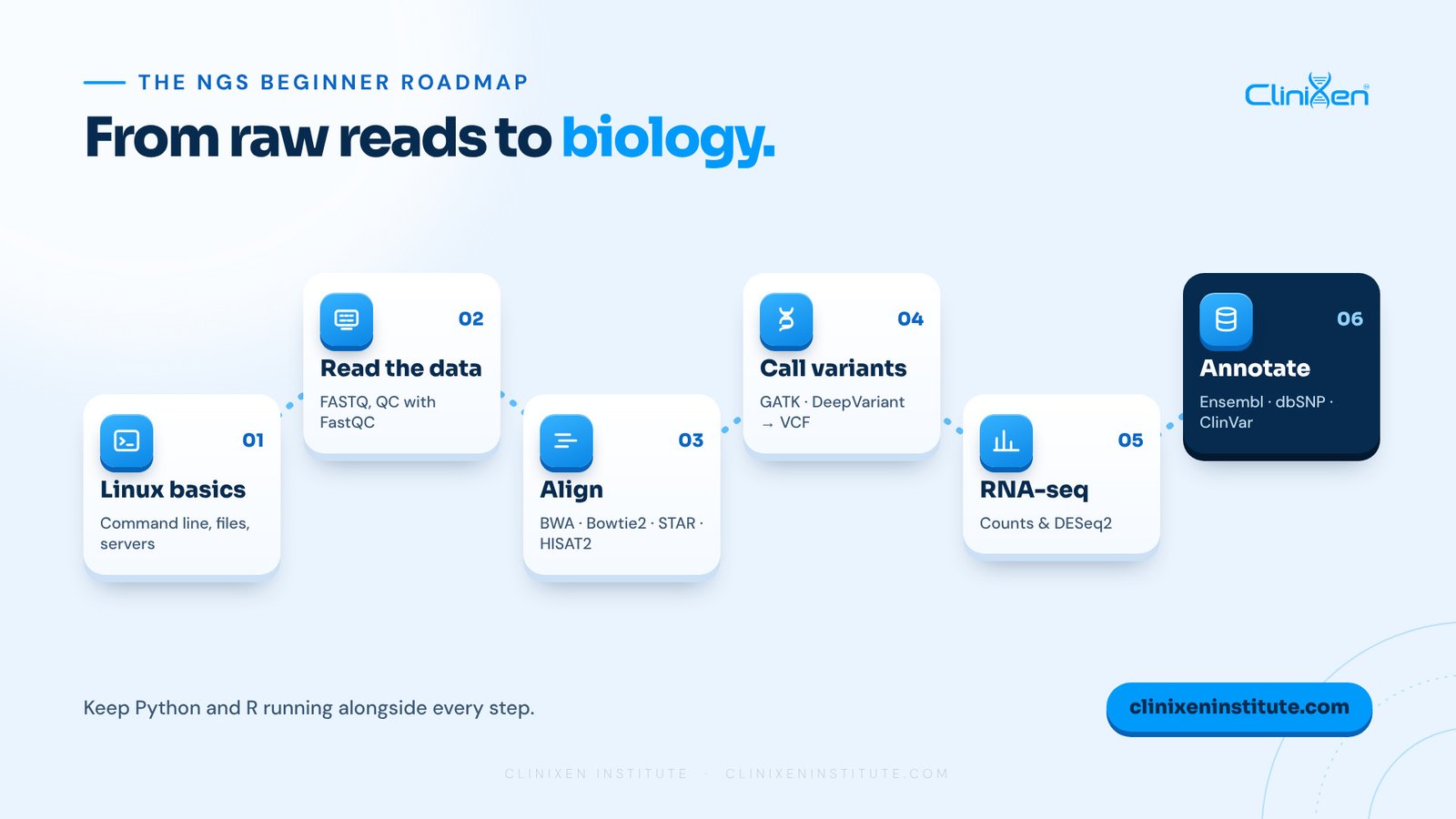
3. Step 1: Understand What NGS Produces
Before any tool, learn the three file types you will meet in almost every project. Each one is a stage in the journey from raw signal to biological meaning.
- FASTQ – the raw reads. Each read has its DNA sequence and a quality score for every base. A single run can produce tens of gigabytes of FASTQ files.
- BAM – the aligned reads. After alignment, each read is placed at its position on a reference genome. BAM is the compressed binary form of the SAM format.
- VCF – the variants. The Variant Call Format lists positions where your sample differs from the reference, with genotype and quality information.
If you can explain what changes between FASTQ, BAM and VCF, you already understand the backbone of a DNA-seq pipeline.
4. Step 2: Quality Control Comes First
Raw reads are never perfect. Some bases have low quality scores, adapter sequences may remain, and some samples may be contaminated. Quality control (QC) checks this before you trust any result.
The standard starting tool is FastQC, which produces a report on per-base quality, GC content, duplication and adapter content. Many teams then trim low-quality bases and adapters before moving on. A good habit from day one: never skip QC, and always look at the report rather than only running the tool.
5. Step 3: Align Reads to a Reference Genome
Alignment (also called mapping) finds where each short read belongs on the reference genome. The right aligner depends on the data type:
- BWA and Bowtie2 are widely used for DNA sequencing data such as whole-genome and exome studies.
- STAR and HISAT2 are splice-aware aligners built for RNA-seq, where reads can span exon–exon junctions.
The output is a SAM or BAM file, usually sorted and indexed with tools such as SAMtools so that later steps can read it quickly.
6. Step 4: Call Variants
Variant calling compares aligned reads with the reference to find single-nucleotide variants (SNVs) and small insertions or deletions (indels). Two names to know:
- GATK (Genome Analysis Toolkit) from the Broad Institute is one of the most widely used toolkits, with published best-practice workflows for germline and somatic variant discovery.
- DeepVariant from Google turns read pileups into images and uses a convolutional neural network (CNN) to call variants. It was described in Nature Biotechnology in 2018.
The output is a VCF file. On its own, a VCF is a long list of differences; the next step gives it meaning.
7. Step 5: Learn RNA-seq Basics
Not every project is about DNA variants. RNA sequencing (RNA-seq) measures gene expression: which genes are switched on, and how strongly, in a sample. A typical beginner workflow is QC, splice-aware alignment (or pseudo-alignment), counting reads per gene and then differential expression analysis.
For differential expression, DESeq2 in R is a standard starting point. It tests which genes change significantly between conditions, such as treated versus untreated cells, while accounting for differences in sequencing depth.
8. Step 6: Annotate with Public Databases
A variant or a gene list becomes useful when you connect it to existing knowledge. These public resources are used every day:
- NCBI – GenBank sequences, gene records and literature links.
- Ensembl and the UCSC Genome Browser – reference genomes, gene annotation and visual genome browsing.
- dbSNP – a catalogue of known short genetic variants.
- ClinVar – reported relationships between variants and human health, with clinical significance classifications.
Learning to search these databases confidently is one of the fastest ways to make your analysis meaningful to clinicians and researchers.
9. The Skills That Sit Underneath Everything
Tools change. Foundations last. If you are starting from a biology degree, build these in order:
- Linux and the command line. Most NGS tools run on Linux servers. Learn to navigate folders, inspect large files and chain commands together.
- Python. Useful for parsing files, automating steps and handling tables of results.
- R. The home of many statistics and visualisation packages, including DESeq2 and Bioconductor.
- Workflow managers. As projects grow, tools such as Snakemake and Nextflow keep pipelines reproducible. Read our comparison: Snakemake vs Nextflow: Which Workflow Manager Should You Learn in 2026?
- Biology and statistics. Knowing what a result means biologically, and whether it is statistically sound, is what separates analysis from button-pressing.
10. Where AI Fits in Genomics
AI is already part of the field, and DeepVariant is a good example of deep learning applied to a classic genomics problem. Machine learning is also used for variant interpretation, gene expression patterns and protein structure prediction.
For a beginner, the message is simple: AI does not replace the workflow above. It works on top of it. The analysts who benefit most from AI are the ones who understand the data, the file formats and the quality checks well enough to judge whether a model’s output makes sense.
11. What Genomics Roles Look Like
Job titles vary between organisations, but entry-level genomics work usually falls into a few groups:
- NGS data analyst or bioinformatics analyst – runs and checks pipelines, from QC to variant calls, and prepares results for scientists.
- Clinical genomics or variant curation associate – reviews variants against databases such as ClinVar and the published literature, usually under the supervision of senior scientists or clinicians.
- Research assistant in a genomics lab – combines wet-lab knowledge with analysis of the data the lab generates.
In all of these roles, employers look for the same things: comfort with the command line, clear understanding of file formats and QC, and the ability to explain what a result means.
12. A Realistic 3-Month Starter Plan
| Month | Focus |
|---|---|
| Month 1 | Linux basics, file formats (FASTQ, BAM, VCF) and FastQC on a public dataset. |
| Month 2 | Alignment with BWA or HISAT2, variant calling with GATK, and annotation with Ensembl, dbSNP and ClinVar. |
| Month 3 | An RNA-seq mini project with DESeq2 in R, written up with plots in a GitHub repository you can show recruiters. |
A small, well-documented project that you can explain end to end is worth more in an interview than a long list of tools you have only installed.
13. Common Beginner Mistakes to Avoid
- Skipping QC and trusting every read.
- Using the wrong reference genome build (for example mixing GRCh37 and GRCh38).
- Using a DNA aligner for RNA-seq data.
- Not recording tool versions and parameters, which makes results hard to reproduce.
- Learning tools without learning the biology question behind them.
14. Start Your Genomics Journey with CliniXen
If you want a structured, mentor-led path through this roadmap, explore the Advanced Diploma in Bioinformatics – Genomics & NGS Data Analysis at CliniXen Institute. You will work hands-on with real-style datasets, from FASTQ to annotated variants and RNA-seq results, and build a portfolio project along the way.
Placement assistance, not a job guarantee.
Genomics & NGS Data Analysis
Go from FASTQ to annotated variants and RNA-seq results with mentor-led, hands-on projects and a portfolio you can show recruiters.
Want to know more? Book a free counselling call or WhatsApp CliniXen at +91 91089 56193.
References
- National Human Genome Research Institute (NHGRI). DNA Sequencing Costs: Data (data to 2022).
- Poplin R. et al. A universal SNP and small-indel variant caller using deep neural networks. Nature Biotechnology, 2018.
- Love M.I., Huber W., Anders S. Moderated estimation of fold change and dispersion for RNA-seq data with DESeq2. Genome Biology, 2014.
- Broad Institute. GATK Best Practices Workflows.
Disclaimer: This article is for educational purposes only. Tools, costs and job roles change over time; always check the latest documentation and official sources before making career or project decisions.